

Princes Street Edinburgh
Attractions and History
Princes Street Edinburgh Attractions
Edinburgh’s famous Street “Princes Street” originally named St. Giles Street after the city’s patron saint, Saint Giles.
King George III, after consideration, rejected the name St. Giles Street as St Giles being the patron saint of lepers and also
the name of a slum area on the edge of the City of London. It was renamed Princes Street after his sons, the Princes.
Princes Street is approximately 2kms in length with shops on the north side and gardens on the south side of the street.
First House in Princes Street
The first house built in Princes Street was No 10 in 1769. This was Silk Mercer (haberdasher) owner
Mr John Neale. Then Pooles Coffee House 1783, then Archibald Constable purchased the house in 1822.

Nor’ Loch
The Nor Loch stretched from under the North Bridge where the Waverley Station is now and in the west at the edge of
St Cuthbert's Church, the Castle Rock and King's Stables Road. The draining of the Nor Loch was required due to the fact that it had been heavily polluted from centuries of sewage draining downhill from the Old Town. The draining of the Nor Loch began in 1759 by way of making a canal that emptied into Lochend at the back of Calton Hill. The Gardens were then laid. In the 1840s the railway was built in the valley, and Waverley Station opened in its present form in 1854. The first station was originally named Canal Street Station where Waverley Market now stands.


Princes Street Gardens
Princes Street Gardens is a public park in the centre of Edinburgh in the shadow of Edinburgh Castle. Before the gardens were formed
(West Gardens Laid 1816-20 and East Gardens Laid 1830), a Loch (Lake) surrounded the Castle Rock, separating the two Gardens West and East is the Mound (building started 1781) which was formed from earth and rubble when the new town was under construction, it became a connection between Old and New Edinburgh.
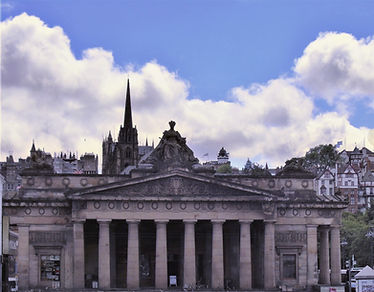
Royal Scottish Academy of Art Mound Edinburgh
The oldest and most prestigious academy of contemporary art in Scotland. The Academy is active in the promotion of young artists from Scotland’s Colleges of Art and Architecture and takes a lead role in promoting living artists in Scotland. Royal Scottish Academy seen with the entrance from Princes Street Edinburgh.

Dean Ramsay Cross
Dean Ramsay was a clergyman in St John’s for 45 years. The Celtic Cross in his memory can be seen at the east end of the church near the entrance to Princes Street Gardens Edinburgh.
St John’s Scottish Episcopal Church,
Daniel Sandford a 26-year-old parson from England opened a chapel in West Register Street in 1794. He was consecrated Bishop of Edinburgh in 1806. Open St John’s in 1818, designed by William Burn. He made Edward Ramsay curator in 1827 when he died in 1830 Ramsay took over. He was appointed Dean of Edinburgh in 1846. A well respected and loved man died in 1872 20,000 lined the streets for his funeral. Procession.


Anne Rutherford
(Mrs Walter Scott Esq)
1733 - 1819
Anne Rutherford was born in 1733 and died in 1819 her grave can be seen on the east side St John’s Church west end Edinburgh. Her father was John Rutherford and her mother Jean Swinton. The Swinton family being one of the oldest families in Scotland. Anne Rutherford was mother of Sir Walter Scott her ninth child, six of which died in infancy.
Sir Walter Scott’s, grandmother was a Halliburton which gave the Scott family the hereditary right to be buried in Dryburgh Abbey. Where Walter Scott is buried with family members.


Sir Henry Raeburn R.A.
1756 -1823
Sir Henry Raeburn R.A. was born in Edinburgh in 1756 and became Scotland’s foremost portrait painter. He lived in Stockbridge area north of Edinburgh. HIs studio Raeburn House where he worked is in York Place Edinburgh an extension of Queen Street which was an original part of Edinburgh’s new town. He was knighted in 1822 and was portrait painter to King George IV. His work can be seen in the Scottish National Portrait Gallery and on the outside wall of the Gallery stands a statue of Sir Henry Raeburn amongst others. A memorial stone is in St John’s Church at the west end of Princes Street close to Sir Walter Scott’s mothers grave.

George Burnett 1822 -1890
George Burnett Lyon King of Arms grave stone is in St John’s graveyard at the west end of Princes Street Edinburgh. George was born in 1822 son of John Burnett, Fifth Laird of Kemnay Inverurie. The family home Kemnay House would pass to Alexander the 6th Laird, George’s older brother.
George became a lawyer in 1845 a member of the faculty of Advocates and was appointed Lord Lyon King of Arms in 1866. He remained in the position until his death in 1890. Lord Lyon King of Arms is the most junior of the Great Officers of State in Scotland and is the Scottish official with responsibility for regulating heraldry in that country.


Lang Dykes - Princes Street
From Multrees Hill on the east to Kirkbraehead (Rutland Square) on the west. This road was called the
' Lang gait,' or 'Lang dykes,' a country road walled on either side with farm lands on the north side.
The main road from east to west now replaced by the New Town. The road now where Rose Street is now.
Princes Street New Town Designed originally by James Craig and built between 1770 and 1823 mainly residential properties with a number of commercial properties
145 Princes Street
originally built as residential townhouses 144-147 the last to be built in Princes Street. 1823. In 1873 the properties were transformed into a luxury Hotel (Osborne Hotel). Change of use when the Scottish Liberal Club took possession and later was changed to retail. The modernisation took place in 1935 when it became Binns Department, and now the Johnnie Walker Experience.
Old Clock
1962 the Clock on the corner of Princes Street and Hope Street was erected in 1962 and twice each hour the miniature Pipers circled the base of the Clock playing the tune Scotland the Brave. This was originally a Binns department store built in 1935 for a company founded in Sunderland in 1811 by a draper called George Binns.

128 Princes Street Edinburgh
Originally built in 1866. The design a grand Italian Palazzo style by
Peddie and Kinnear Architects originally built as the University Club, a private gentlemen's club. With Corinthian columns and a bow window on the first floor.


123 Princes Street
Originally built as a townhouse, in 1869 and in 1873 the exterior of the building was finished in a grand Victorian style

112 Princes Street
The building at 112 Princes Street in Edinburgh was built between 1882 and 1884. It officially opened on 1 February 1884 as the purpose-built clubhouse for the Edinburgh Conservative Club. This building housed the Gladstone Memorial Library on the first floor.
-
In 1978 112 -109 were joined inside to make one large store on the upper floors when completed Debenhams opened in 1981 in May 2021 Debenhams store closed.

100 Princes Street
Originally built as a town house for Lady Mary Clerk of Penicuik in 1798 after her husband’s death. In 1877 it became Dejay's Hotel opened by a Frenchman Calixte Dejay in 1879 it was purchased by Albert Thiem of German heritage naming it the Windsor Hotel. It then was purchased by the over-seas League and opened as
The Royal Over-Seas League Edinburgh’s first mixed-gender
private members' club.

90 Prince Street
Originally a town house built circa 1780 where wealthy families lived. In 1866 A jeweller purchased the retail unit on the ground floor and opened his newly founded business in Princes Street the Jeweller being James Hamilton and his nephew, Robert Inches (who was knighted in 1915). In 1887 with success more space was required and they purchase r premises at No 88. combining the stores. They then purchased 87 George Street and moved in 1952 and still remain. The upper residential floors of 90 was a Turkish Baths from 1861 until circa 1920.

61 -62 Prince Street
Originally built in 1780 as a town house residence Romanes and Paterson moved here in 1884 after the building was redesigned in 1870 to what you see today.

109 - 110 Princes Street
It was built between 1770 - 1800 as private residences. In 1869
it was replaced with a new building as the luxury The Grand Palace Hotel. It then became the Scottish Liberal Club in 1890 and housed
the Gladstone Memorial Library including bust of William Gladstone ) on the first floor. In 2023 The Gladstone Memorial Library, was sold by the Debenhams an is now located in Church Lane, Hawarden, Flintshire, CH5 3DF (North Wales, roughly 6 miles from Chester).

97 - 98 Princes Street
-
Built in 1786 designed by James Craig a three-story and attic stone building on the corner of Princes Street and Frederick street with a main entrance hall and reception areas to welcome their visitors. This was the first tenements (based on a large Town House) of the new town and one of the only that still remain. The ground floor area was converted into a retail unit circa 1840.
-
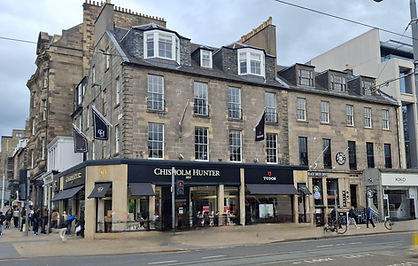
70 -71 Prince Street
The original area was built as a town house by James Craig circa 1780. With its first resident Scottish legal writer and inventor John Clerk of Eldin who lived here with his family until his death in 1812.
The future transformed town house into mixed use, with shops on the ground and basements this town house was demolished and rebuilt as you see it know as the Edinburgh Café built in 1887 in the North European Renaissance style. The Edinburgh Café was sold and changed into mixed use ground floor retail and upper residential. In 1922 D. S. Crawford redesigned the building into
Crawford’s Tea Rooms (the place to be seen).

60 Princes Street
John Dickson & Son Scottish Gun and Rifle maker opened in 1838 closed 1923. The Building was rebuilt in 1903 to what it is today, A Jacobean styled town house built for the owners Turnbull & Co retailers Opticians and Sporting Goods
(fishing equipment).
They moved in 1929 to 37 George Street.
In 1930 J Woodhouse & Son A furniture and household goods store was here until 1960. The Upper floors were used as a Studio and occupied by a number of Photographers over many years

John Menzies
61 Princes Street
John Menzies moved from London to Edinburgh at the age of 25 and opened a book shop in 1833 at 61 Princes Street, Edinburgh. With in a few years it became what is now known as a newsagents, being the first to sell The Scotsman newspaper
(another business still trading) over the counter. John Menzies is now Menzies Aviation and is still going strong.
48 Princes Street
Jenner's Department Store
(one of the world's first department stores)
The original store opened in 1838 by 2 out of work drapers Charles Jenner and Charles Kennington at 47 Princes Street.
The store grew with its popularity of fine goods and over time acquired 2 further premises in Princes Street and 8 in
South St David Street to make it the largest department store in the United Kingdom. In early 1860s when Charles Kennington retired Charles Jenner became sole proprietor. The Store was burnt to the ground and rebuilt in 1893 by the same architect that designed the North British Railway Hotel (The Balmoral). The reopening of Jenner’s was in 1895 and was successful as an independent Department store until the House of Fraser group took over in 2005. Not surprisingly the Royal Warrant was awarded to the store in 1911 as the Royals at the time were frequent customers


43 (No.42 - 46) Prince Street
As building from the 1770's this block were town houses until 1883 one of the only survivors. In 1800 it changed to commercial on the (ground floor) and offices above. In 1848 No. 43 was Scotland's first temperance Hotel. (Waverley Hotel) Owned by the Cranston family until 1953. It Became the Old Waverley Hotel in 1868 as the Cranston's' opened a further hotel the
New Waverley Hotel. In 1883 No.42 - 46 were demolished to what you see today.
30 Princes Street
The Forsyth Armillary Sphere
Princes Street Edinburgh First steel framed Building in Scotland. An icon of the Edinburgh skyline for over one hundred years. This corner building was the first to be built with a full steel-frame in Scotland date 1906. The corner store features the Forsyth Armillary Sphere which has the signs of the zodiac around the centre with 3 Gilt cherub figures holding the sphere in place.


20 Prince Street
No. 19 and No. 20 were rebuilt in 1837 Victorian Town Houses The Royal British Hotel was later Built on the site in 1899

North British Station Hotel
(The Balmoral Hotel )
Edinburgh
The North British Station Hotel (The Balmoral) opened for Business in 1902 and is positioned next to the Waverley Station Between Waverley Bridge and the North Bridge, which gives direct access to Edinburgh’s old town, The Royal Mile, The Castle and The Palace of Holyrood House (Holyrood Palace). Directly behind the hotel is Calton Hill. The Hotel is at the east end of Princes Street, one of the most famous and picturesque streets in the world. The clock has historically been set 5 minutes fast giving rail travellers the illusion that they are late for their train. The site it stands on is where the first ever hotel in Edinburgh stood. The first hotel being The Crown in 1811 and then changed to Royal Eagle and Prince Regent before being demolished to make way for modernisation and the building of the present hotel.

Edinburgh’s Waverley Mall and Waverley Train Station
The Waverley Train Station entrance in Princes Street is one of 4 entrances into the Waverley rail Station which is below street level. The Station was built in 1854 and is the main rail station in Edinburgh where you can travel in all direction with a direct line to London with a journey time of just over 4 hours. There are trains to Highlands, Glasgow, the Scottish Borders all points north and south.
Original Canal Street Station


Multrees Hill
The Street's name Multrees Walk is derived from the family Montrays who lived here in the reign James V. The hill taking its name from the family. The hill was on the highest point before Calton hill and was used for hangings and displaying the dead on poles as a deterant to others. Later the area of Multrees Hill, was developed into a small village of workshops prior to the new town and North Bridge being Built.
Register House Princes Street Edinburgh
Register House can be found at the foot of North Bridge Edinburgh built on what was at the time called Multrees Hill.
It was opened in the 1790 and New Register House on the west side of the building in West Register Street was completed in the 1858. The buildings were built to store records of registry (births, deaths and marriages) and is also where the Tartan registry is now housed. Directly outside Register House can be found the Duke of Wellington’s statue which was erected in 1852 in memory of the Battle of Waterloo. Waterloo Place leading to the Calton Hill is also named in memory of the
Battle of Waterloo which took place in 1815.


Duke of Wellington Statue Princes Street Edinburgh
Directly outside Register House can be found the Duke of Wellington’s statue which was erected in 1852 in memory of the Battle of Waterloo. Waterloo Place leading to the Calton Hill is also named in memory of the Battle of Waterloo which took place in 1815. The name of the horse erected in 1852. The Horse was called Copenhagen.

Ritchie Clock
Edinburgh Circle
The clock that can be found on the west side of the Wellington Statue is a clock that was part of the “Edinburgh Circle” a number of electronic clocks placed around the city by Frederick James Ritchie to give the correct time to Edinburgh’s residents.
