

Qué hacer en Cowgate
Edimburgo
Cowgate Grassmarket Edimburgo era el camino hacia Edimburgo desde el este. anteriormente el lago sur antes de drenado alrededor 1300. El nombre de la puerta en el muro Flodden que rodeaba Edimburgo. La Puerta era la forma en que los granjeros llevaban su ganado (vacas) al mercado. A través de la puerta de la vaca de la muralla de la ciudad (muralla Flodden). Ahora es el centro de pubs, restaurantes, discotecas, a poca distancia de todas las atracciones, sitios históricos, Royal Mile y el Castillo de Edimburgo. Hay algunos lugares que todavía existen en Cowgate desde Historia de Edimburgo; La Capilla de la Magdalena, James Connolly lugar de nacimiento, Iglesia de San Patricio, una de las escuelas de George Heriot, Tailors Hall, el primer puente para balneario de Cowgate (South Bridge), las bóvedas creadas por el puente que una vez se utilizaron como tiendas La historia de Edimburgo es vasta y espero haber dado una buena cuenta de ello en este sitio.


Cowgate Port + St Mary’s Port
St Mary’s Port across the Pleasance from Heriot’s Hospital to a building at the head of Back of Canongate South (now Holyrood Road). Cowgate Port across the Cowgate from Heriot’s Hospital to buildings on North of Cowgate.


Hospital de Heriot (escuela)
Cowgate Edimburgo
Heriot's Hospital (Escuela) Cowgate estaba en un edificio en la esquina de Cowgate y Pleasance en Edimburgo. Se construyó después de que se quitaron el muro y el puerto de Cowgate para su desarrollo y es posible que la piedra del muro se haya utilizado para construir el Hospital (escuela). Este edificio todavía está en pie originalmente construido entre 1838-1840, la esfera del reloj tiene una fecha de 1840 y en el frente del edificio hay una inscripción de George Heriot | Hospital | Escuela | 1838 Esta es una de las siete escuelas abiertas por los gobernadores de la escuela de Heriot para educar a los niños pobres en toda la ciudad.


RC de San Patricio
Cowgate Edimburgo
St Patrick's Edinburgh se construyó en 1774. Primero fue presbiteriana, luego episcopal y finalmente en 1856 se abrió como iglesia católica para servir a la creciente comunidad irlandesa en Edimburgo. Se informó que hubo 2600 asistentes al primer servicio. En 1869, el canónigo Edward Hannan estableció la Sociedad Católica de Hombres Jóvenes (CYMS) y comenzó un equipo de fútbol para ayudar a la comunidad católica irlandesa de Edimburgo Southside se mezcla con la comunidad católica más grande de Edimburgo. Después de que se rechazaron muchos nombres diferentes, se decidió que el club de fútbol debería llamarse Hibernian después del nombre romano de Irlanda. El Hibernian Football Club ha sido parte de la historia deportiva de Edimburgo desde entonces.

Placa Cardinal Beaton
Cowgate Edimburgo
David Beaton nació en 1494 y murió en 1546. El 20 de diciembre de 1539, David Beaton fue nombrado cardenal por el Papa Pablo III. El cardenal Beaton se convirtió en regente de María, Reina de Escocia y se nombró a sí mismo Canciller de Escocia en 1543. No era del agrado de la mayoría, pero estaba a favor de la realeza de Francia y Gran Bretaña. Tuvo muchas amantes y 20 hijos ilegítimos. Fue arrestado por fraude y la causa del cortejo rudo, Enrique VIII, invasión de Escocia.

Placa Cardinal Beaton
Cowgate Edimburgo
David Beaton nació en 1494 y murió en 1546. El 20 de diciembre de 1539, David Beaton fue nombrado cardenal por el Papa Pablo III. El cardenal Beaton se convirtió en regente de María, Reina de Escocia y se nombró a sí mismo Canciller de Escocia en 1543. No era del agrado de la mayoría, pero estaba a favor de la realeza de Francia y Gran Bretaña. Tuvo muchas amantes y 20 hijos ilegítimos. Fue arrestado por fraude y la causa del cortejo rudo, Enrique VIII, invasión de Escocia.


Primera imprenta
Caballero negro
Esta placa dona el lugar donde tuvo lugar la primera impresión de un libro en Escocia. Los impresores Walter Chepman y Andrew Myllar imprimieron el primer libro en 1508 después de que King (James IV) les concediera una licencia un año antes.
Los impresores estaban en Cowgate, al pie de la calle Blackfriars, cerca de la casa del cardenal Beaton.

Placa de Robert Louis Stevenson
Cowgate Edimburgo
"Mirar por encima del Puente Sur y ver el Cowgate abajo lleno de vendedores ambulantes llorando, es ver un rango de la sociedad de la madre en un abrir y cerrar de ojos". Robert Louis Stevenson 1878. La placa se puede encontrar en la pared de los Rowantree a Venue en Cowgate, Edimburgo EH1 1NN cerca del South Bridge.

South Bridge
Bridges over Cowgate
The South Bridge was constructed circa 1788, due to the ground and valleys the bridge was constructed with
19 arches. The arch that spans the Cowgate is the only one that is visible. Underground can be seen vaults that were made due to the bridge. The vaults were occupied by tradesmen, shops and taverns the first underground shopping mall. Due to the conditions of the vaults with lack of light and air, the vaults were soon abandoned.
Cowgate to St Mary’s Street Cowgate to George IV Bridge


Underground Vaults
The South Bridge was constructed circa 1788 due to the ground and valleys the bridge was constructed with 19 arches. The arch that spans the Cowgate is the only one that is visible. Underground can be seen vaults that were made due to the bridge. The vaults were occupied by tradesmen, shops and taverns the first underground shopping mall. This did not last due to the conditions of the vaults with lack of light and air, the vaults were soon abandoned. It is not known when the vaults complex was closed down, with some suggesting as early as c. 1835 and others as late as c. 1875. Written records regarding the vaults during their slum use are virtually non-existent. There are areas within The Caves that are the building remains of what was Adam Square, which was demolished to make way for the erection of the South Bridge. The original terracotta floor tiles, a hearth stone, and what remains of a fireplace, were found in one of the rooms within The Caves whilst it was being excavated. In another room, within The Caves, a well was found. South Bridge started in 1785, when the 19 arches to support it were built. The vaults, chambers and tunnels underneath it were walled in and sectioned off the descending levels. By 1788, when South Bridge was officially opened, approximately 120 vaults, or rooms, were ready.

Blair Street
Blair Street was formed when the South Bridge was being built in 1768. To give access to the Cowgate from the High Street, at that time Marlin’s Wynd and Pebble's Wynd were demolished in 1785 with the west side of Niddry Street. Blair Street as Hunter Square was named after Lord Provost Sir James Hunter Blair.
Marlin’s (Merlyoune) Wynd
Marlin’s Wynd is below the level of the present streets as Mary King’s Close is. Marlin’s Wynd was to the west of the Tron Kirk and ran down to the Cowgate. Named after John Merlyoune (Marlin), who was in charge of paving the High Street. He requested in memory of his work that he would be buried underneath the paving stones. He was buried at the head of the Wynd (which was named after him) by paving stones in the shape of a grave. Other writings mention that the High Street was paved in 1532 by two brothers John and Bartoulme Foliot.
Also a John Merlyoune was first to pave Marlin's Wynd 1542.

Free Cowgate Church (Stramash)
Church built in 1859, was built by Edinburgh architect Patrick Wilson.
The panel above the door reads;
'Erected and endowed from funds bequeathed by William Whyte Edinburgh MDCCCLXI’.

Guthrie Street | College Wynd
Guthrie Street was built to replace College Wynd and was named after Dr Thomas Guthrie the founder of the first Ragged School in 1841, which can be seen in Ramsay Lane of Castlehill Royal Mile Edinburgh. Guthrie Street is a link between Chambers Street and the Cowgate Edinburgh. There are steps from Chamber Street to Guthrie Street which was previously West College Street before Chamber Street was built.
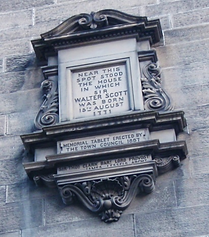
Walter Scott was born in College Wynd which was demolished and replaced with modern housing. The plaque can be seen on the wall at the corner of Guthrie Street and Chambers Street is to signify the location of the house where Sir Walter Scott was born in August 1771. Walter Scott's Birthplace Stone Guthrie Street Edinburgh


Old Fishmarket Close Swift’s Wynd Carmichael's Close
The Fish market was one of the casualties of the Great 1824 fire as it was destroyed. This close was originally known as Swift's Wynd a narrow street joining the Cowgate to High Street, the name recorded as far back as 1539. Alexander Swift owned a cellar at the head of the close and John Swift, a tenement. It then became Carmichael's Close in 1722 after Mr William Carmichael, advocate that lived there with his family. It was later renamed Fishmarket Close due to the fish market that was once active there. George Heriot known as “Jinglin’ Geordie”, the kings Jeweller and the founder of George Heriot’s Hospital (school), also lived in the close.
This was also a close that housed the first firefighting appliance.
At the foot of the Close on the west side was a property that was provided by the Council for the executioner. This gave the executioner easy access to both the Lawnmarket and Grassmarket place of Execution by hanging or beheading. The house also provided a prison room for the condemned on the night before their demise.


Salón del sastre
Cowgate Edimburgo
La incorporación de Tailors de los registros de Canongate se remonta a 1438 (registros nacionales de Escocia). La incorporación de Tailors compró terrenos en Cowgate en 1620. El sitio fue donde construyeron su sala de reuniones que se completó al año siguiente. En febrero de 1638 se aprobó una copia del borrador del Pacto Nacional en el Tailor's Hall. El edificio se amplió en 1757 mediante un piso superior. Los edificios ahora son un bar y alojamiento. El Pacto Nacional se firmó por primera vez en el cementerio de Greyfriars en Edimburgo el 28 de febrero de 1638 antes de viajar por el país en busca de firmas.

Puentes que atraviesan
Cowgate Edimburgo
los Se construyeron 2 puentes que atraviesan el Cowgate en Edimburgo para permitir el acceso al sur de Edimburgo. El South Bridge se completó en 1788 y fue una extensión del North Bridge y cruzó High Street en Tron Kirk, que fue durante mucho tiempo el marcador central del Viejo Edimburgo. El puente George IV se completó en 1832, que partía de Lawnmarket y era una continuación de Bank Street y Mound. Muchas casas y cierres fueron demolidos para dar paso a los puentes para permitir conexiones fáciles con el sur de Edimburgo. Las oficinas de la Compañía de Comerciantes de Edimburgo era donde se encuentra ahora el arco del puente George IV. Aquí fue donde se estableció la primera escuela de mujeres. por un regalo de Mary Erskine en 1694, conocido como Merchant Maiden Hospital.


James Connolly Birthplace
James Connolly was born in Edinburgh at 107 Cowgate on 5 June 1868. The first time he stood on Irish soil was as a British soldier at the age of fourteen. He was the secretary of the Scottish Socialist Federation in 1892 aged 24.
He also founded the Irish Socialist Republican Party whose aims were to secure the national and economic freedom of the Irish people. He started a weekly newspaper, the Workers’ Republic and the first publication was issued in August of 1898. At the age of 46 in 1914 he became Acting General Secretary of Irish Transport and General Workers Union. He formed an Anti-War Committee and as the leader he Committed the Labour movement to oppose recruitment and conscription to the British Army ‘we serve neither King nor Kaiser, but Ireland’. When the Secret military council of the I.R.B. Decided on an armed rising in 1916, Connolly took part in the preparations and in 1916 he had become convinced that a nationalist revolution was the only way to free Ireland from what he saw as imperial and capitalist oppression. He was sentenced to death for his part in the uprising and was executed in Kilmainham Jail Dublin 12 May 1916.


Merchants of Edinburgh – Merchant Maidens Hospital
Merchant Company of Edinburgh
The Merchant Company of Edinburgh was established in 1681. The previous name was the Guidry before it became a society. Their first meeting hall was in the Cowgate Edinburgh and they then moved to Hunter Square before moving to its final home of Hanover Street. The Merchant Company was a watch dog for Edinburgh looking after the concerns and needs of the people. Over time the wealthy would leave their estates to be administered by the Merchant Company by way of a trust. This resulted in with well-judged investments the Merchant Company become the largest land owners in Scotland. The Merchant Company in 1694 with a donation from Mary Erskine a widow, which established Mary Erskine School. With other donations and bequests and trusts, further education facilities were opened, George Watson’s College in 1741, George Watson was an accountant, and merchant banker and the first accountant of the Bank of Scotland, James Gillespie’s High School in 1803, James Gillespie was a local Tobacconist in the High Street Edinburgh and Daniel Stewart held an appointment in the Court of Exchequer, Daniel Stewart’s College in 1855 which is now ESMS (Erskine, Stewart, Melville Schools). John Watson’s School in built in 1828 at 75 Belford Road next to the Dean Cemetery. The Edinburgh Chamber of Commerce was established as an off shoot of the Merchant’s Society of Edinburgh in 1786.
Magdalen Chapel Cowgate
The Magdalen Chapel was built by Michael Macquhane and his wife Michael died in 1537 and his wife managed the completion of the chapel in 1542. The Magdalen Chapel was a chapel and Hospital for the poor. The Incorporation of Hammermen took over the running of the building in 1547. On the plaque above the door show their initials MM. JR. and the date of Janet Rynd's death 1553. The Chapel was a place of worship and also the guild Hall for the incorporation of Hammermen. The Hammermen were metal workers and tradesmen who became the trustees of the Chapel and attached building a hospital, which is now a hostel. Inside the Chapel is an amazing stain glass window which features the Royal Arms of Scotland, the Arms of Mary of Guise, Mary Queen of Scots. mother Also still in the Chapel is the Deacon of the Hammermen's Guild of Edinburgh chair which was made in 1708. There are many other artefacts from Scottish history on display in the Chapel please arrange a visit as there is much to see.

Medical Missionary Society | Livingstone House
Edinburgh Medical Missionary Society moved into 39 Cowgate in 1858 which was then owned by the Scottish Reformation Society. The EMMS (Edinburgh Medical Missionary Society and Livingstone Institute) rebuilt in 1877 and operated a dispensary for the local people. The building occupied from the corner of Candlemakers' Row to the Magdalen Chapel. Above the entrance on the corner are 13 carved heads. The building housed a dispensary, waiting rooms, lecture theatre, students' bedrooms (the Livingston Residence), a working men's club and 3 shops.

Grapes

Frog

Plums

Knight’s Templar


Thistle

Acorns

English Rose

Devil


Cowgatehead Free Church
The Gothic church was founded in 1861 with money from William Whyte’s will. William Whyte bookseller to the Queen Dowager Adelaide wife of William IV. The stone panel on the tower above the door reads; 'Erected and endowed from funds bequeathed by William Whyte Edinburgh MDCCCLXI
