

Viajes y excursiones a Edimburgo
D
Taxis negros de Edimburgo
Los taxis negros de Edimburgo tienen conductores calificados probados por el consejo.
Los taxis negros de Edimburgo se pueden contratar en la calle o reservar por adelantado por teléfono o descargue la aplicación.
Los taxis negros pueden llevar pasajeros a cualquier parte del continente. Bretaña.
Taxi negro de Edimburgo los precios se cobran mediante tarifa con taxímetro, a menos que se haya acordado previamente un precio fijo.
Free Dean Village Tour
Explore the captivating history and stunning architecture of Edinburgh with our walking tours. Discover iconic landmarks along the Royal Mile, including the Calton Hill, home to remarkable monuments and breathtaking views. Stroll through the picturesque Dean Village, and about the famous figures who shaped this vibrant city. Join for an unforgettable journey through Edinburgh's rich heritage and charm!
For more details on tours click the yellow link
Dean Village Tour + Route + Map (Free)
For The History and images of all the sites on route
Dean Village
Dean Village was a small village outside Edinburgh known as Water o Leith Village, and was famous as a grain milling area for over 800 years. The name Dean (Dene) meaning Deep Gorge. The village has steep hills on all sides.
The Dean Village with the Water of Leith flowing through, grew as a community in the 1100s from the many mills that were built on the river banks. You will see many stones carved with crossed paddles of the bakers, as this area supplied all the bakers of Edinburgh with their flour.
The Incorporation of Baxters (bakers) was a crucial role in Dean Village, controlling the grain milling industry from the 12th century. Mills were first mentioned in 1143 by David I.
Places to see on the route
Randolph Cliff
No.9
Belford Road
Old Drumsheugh Toll House, Lynedoch House
Dean Bridge
Kirk Brae House, View Dean Village,
Randolph Cliff Arches
Queensferry Road
Trinity Church, Belgrave, Buckingham,
Bristo Baptist Church
Dean Path
Dean Church, Dean Cemetery, No.29,
Dean Village School, West Mill, Well Court
Dean Village
Waterfall, Foot Bridge, Hawthornbank Houses,
Merchant’s House, Bell’s Brae Bridge,
Granary + Old Tollbooth
Water of Leith Path
Miller Row, Waterfall, Mill wheels,
St George’s Well, St Bernard’s Well
Nelson Memorial, The Dene Steps
St Bernard's Bridge
Places to see on the route
Danube Street
No 17
Ann Street
Sir Henry Raeburn - No. 29
India Place
Duncan’s Land
Doune Terrace
Robert Chambers House No.1
Gloucester Place
John Wilson AKA Christopher North No.6
Moray Place
No.1 Graham No.24 Fettes No.37 Hume
Forres Street
No.3
St Combe Street
Catherine Sinclair Monument
Charlotte Square
6 Bute House, 7 Georgian House,
9 Lord Joseph List, 13 Lord Henry Cockburn,
14 Sir William Fettes, 24 Earl Douglas Haig,
45 Professor Sir Robert Philip,
Albert Memorial, Register House.
South Charlotte Street
Alexander Graham Bell No.16
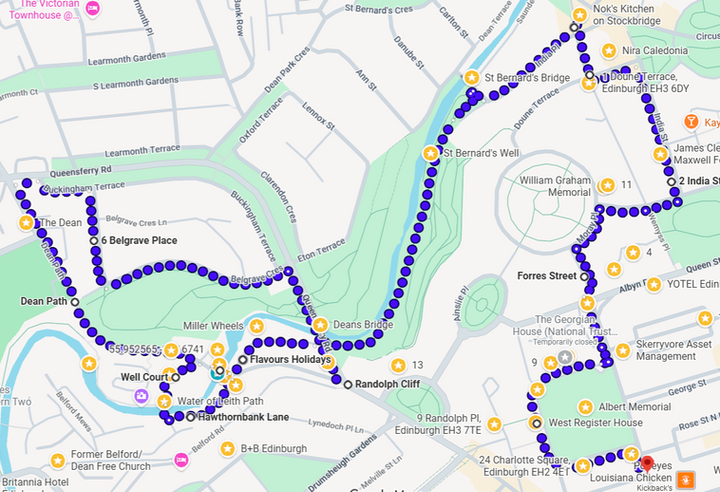
Randolph (10th Earl of Moray)
The streets named Randolph were named after Thomas Randolph, 1st Earl of Moray, nephew and lieutenant of Robert the Bruce.
He made a night-time raid, scaling Edinburgh Castle rock or Cliff in 1313 and recapture the Castle from the English army who had been in occupation for
20 years. On the death of Robert 1st in 1329, Thomas Randolph became Regent of Scotland for the young King (David II). He was believed to have been murdered by poisoning on July 20, 1332, in Musselburgh.
In 1822, the 10th Earl of Moray a land owner instructed the famous architect James Gillespie Graham to design an extensive, high-end residential estate on his 13-acre Drumsheugh lands. Joining the West New Town with The New Town.
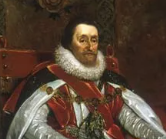

1 Randolph Cliff
Randolph Cliff built at the top of the Dean Gorge overlooking the Water of Leith and part of the Moray Estate was completed in 1831 designed by James Gillespie Graham. The houses were built on a number of underground arches to prevent the terrace and surrounding streets from collapsing and sliding into the Gorge. Famous resident at No.1 was Sir George Washington Browne a renowned architect and a former
President of the Royal Scottish Academy. His work includes Holyrood Palace gates, Caledonian Hotel, Central Library 69 George Street (British Linen Bank) and many others some of which have been demolished.

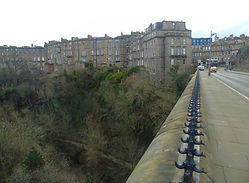

Drumsheugh Toll - Lynedoch House
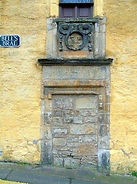
Lynedoch House was built in 1891 around an older and smaller house called Drumsheugh Toll, a cottage built circa 1820 for the tollgate keeper, where a toll gate and weighing machine stood for payment of tolls to use the road to the Queensferry. Lynedoch House was built as a family home and a studio for Charles Martin Hardie RSA a successful artist, for paintings of Scottish life and also portraits of Robert Burns and Walter Scott. Notice the stucco around the lower courses of the building, impressed with the motif of an H, (Hardie) an eagle and a thistle along with love hearts in the original cast iron window bars: The thistle for Scotland and the eagle for America, where his first wife, Mary Lewis came from. The heart was a symbol of their love. A marriage that did not last as she ran off with an actor. The name Lynedoch was already a local place name, having been applied circa, 1820 the landowner Major James Weir RM (Promoted to Major by Lord Nelson for his service at Malta) in honour of Major Thomas Graham, 1st Baron Lynedoch, who raised the regiment the 90th Light Infantry - Perthshire Volunteers a military Commander and Member of Parliament for Perthshire.


Dean Bridge - Kirkbrae House
Dean Bridge - Kirkbrae House
The house on the corner of the bridge was the home of Cabbie Stewart, the owner and driver of a horse and cab hire.
Stewart would collect old stones while working his cab from old buildings. Kirkbrae House is on 5 floors the stables were on the basement with access next to the water of Leith path. The house was also at times a Tavern and Bakers, the square panel on the wall shows a sun with two arms below, one holding scales and the other a wheat sheaf, with two baker’s paddles crossed One of his acquisitions from an old mill.
The inscription on the plaque reads:
IN THE SWEAT OF THY FACE SHALT | THOU EAT BREAD | GEN 3 VERSE 19 | ANNO DOM 1619
Known as ‘The Baxter’s Stone. Put on this wall in 1893 from a demolished mill.
Above the door is PAX INTRANTIBUS - PEACE TO THOSE WHO ENTER
And on the wall and the Edinburgh coat of Arms
NISI DOMINUS FRUSTRA – Without the Lord everything is in Vain


The Dean Bridge
The Dean Bridge was designed by Thomas Telford, and was completed in 1832 and opened in 1833.
The Dean Bridge was Thomas Telford’s last project at the age 73 and retirement. The Dean Bridge with 4 arches is 447 feet long (136m) and 39 feet wide (12m) and built on four arches rising 106 feet (32m) above the river. Prior to the building of the Dean Bridge the only way across the river in to Edinburgh was by a ford in the river, which had been crossed since medieval times (5th to 15th centuries). A bridge, of wooden structure across the water of Leith was built in the 5th century. It is now a stone bridge (Bell’s Brae Bridge). The building of Dean Bridge gave access to the north for further extension of Edinburgh’s New Town.
Looking over the Dean Bridge West the Dean Village, East the New Town Randolph Cliff built on series of underground stone arches. The arches protect Randolph Cliff, Randolph Crescent, Great Stuart Street, Ainslie Place, and Moray Place from tumbling down into the Water of Leith. Designed by 1822 by, architect James Gillespie Graham for Francis Stuart, the 10th Earl of Moray on the Moray Estate which covers most of the western new town.

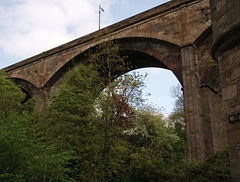
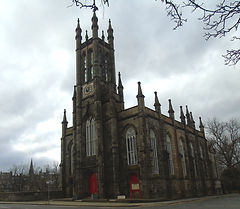
Holy Trinity Episcopal Church
Gothic church at the North end of the Dean Bridge. The church is in its original state from when design / built by John Henderson, 1837-8. Henderson has built many churches in Scotland to a Gothic design. The church was converted into an electric sub-station in 1957. It is now the Rhema Christian Centre Church.
Belgrave and Buckingham Area
Belgrave Crescent was built on land bought by property developer and Lord Provost of Edinburgh James Steel, Designed by John Chesser and completed in 1874. The land between Water of Leith and the new houses also purchased by Steel, which became private gardens for the residents. The gardens designed by James Jeffery and completed in 1876.Buckingham Terrace was also part of the Steel development designed by Chesser which was completed in 1831.


The Dean Parish Church
The first church in Dean Path was built in 1836 then demolished and replaced by the present church in 1903. This was the main church for the Dean Village population. With the reducing congregation the church closed in 2006. It is now known as The Dean and is used as an Assembly Hall and Event Venue for the nearby Erskine Stewart’s Melville Schools (ESMS).
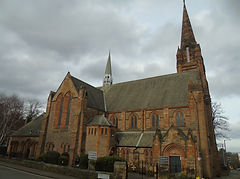
Bristo Baptist Church
In 1765 in Bristo Place Original Scotch Baptist Church ‘the Scotch Baptist Church’ Bristo Baptist Church is the mother church for the Baptist movement in Scotland. A purpose-built chapel was constructed at Bristo Place in 1836.
The designation ‘Scotch’ was discontinued from the church’s title in 1927. In 1932, the present site here on Buckingham Terrace was purchased for £1,000 In October 1933, the Memorial Stone of the new building on Queensferry Road was laid and the first service took place on Wednesday, 20th February, 1935. The church has a long history and is the second oldest Baptist church in Scotland Bible on Dean Path side inscription: SEARCH THE SCRIPTURES S. JOHN V. CH.39


Dean Cemetery Edinburgh
The Dean Village is named from Dean House and the Nisbet family who owned the lands. The House was demolished in 1843 and in 1845 the Dean Cemetery was created. A carved heraldic panel from Dean House, now installed on a wall in Dean Cemetery, is decorated with three boars’ heads around a chevron, all surrounded by a wreath of oak leaves, and carries the initials HN for Henry Nisbet born 1535 who died in 1608
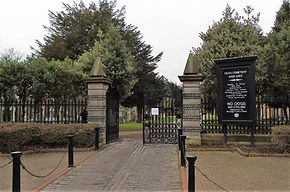
Some of the Famous Graves in Cemetery
David Octavius Hill, Colonel Robert Smith, James Buchanan, Lord Francis Jeffrey, James Falshaw James Nasmyth, Alexander Nasmyth Artist, Lord Henry Cockburn, Robert McVitie, Lord Andrew Rutherfurd, James Hamilton, Sir Thomas Bouch, Alexander Russell, James Stevenson, William H Playfair, George Combe, Cameron Highlanders Obelisk, Robert Chamber, Sir John Ritchie Findlay, Thomas Drybrough,
Flora Stevenson, Louisa Stevenson, Elsie Inglis, Dr Joseph Bell (see separate page)
Dean Village
Dean Village was a small village outside Edinburgh known as Water o Leith Village, and was famous as a grain milling area for over 800 years. The name Dean (Dene) meaning Deep Gorge. The village has steep hills on all sides. The Dean Village with the Water of Leith flowing through, grew as a community in the 1100s from the many mills that were built on the river banks. You will see many stones carved with crossed paddles of the bakers, as this area supplied all the bakers of Edinburgh with their flour. The Incorporation of Baxters (bakers) was a crucial role in Dean Village, controlling the grain milling industry from the 12th century. Mills were first mentioned in 1143 by David I.
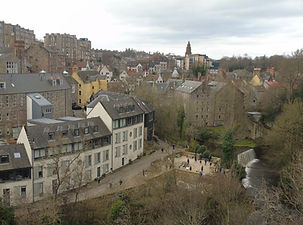
29 Dean Path
The house on Dean Path dates from circa 1790 with a Victorian-era post box with a ("VR" Cypher) circa 1850 still present. This may have been the post house in its time. The tenements in Dean Path, now all demolished and rebuilt, were where most of the families lived.

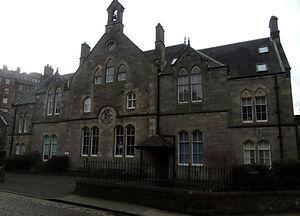
Dean Village School
The Old School house on Bell’s Brae was built in 1872 and a historic part of the Dean Village. The public school educated the local children until it closed in 1961. It was able to hold up to 400 children by 1961 there were only 37 pupils. Carvings can be seen "Education" above the ground floor windows and a tablet on the front with the words “Edinburgh School Board 1875”
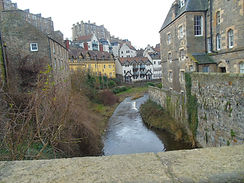
Old West Mill Building
The stone building over the bridge with round windows is the Old West Mill, built in 1805. At the top of the building you can see a wheat sheaf. The mill is one of few surviving examples in the Dean Village of its former industrial heritage. Particularly based on grain milling, many of which utilised power provided by the Water of Leith.

Bells Brae Bridge
In the centre of the Dean village is the Bells Brae Bridge which was the original crossing point of the Water of Leith as it was shallow and narrow. Getting to and from Edinburgh this the only crossing. In the 5th century a single arch bridge which was wide enough for a carriage with horses. The Dean Village stands below the Belford Bridge which was built in 1887 to carry Belford Road. Bells Brae Bridge was built in 1830 replacing previous bridges, the old road from Edinburgh to Queensferry.

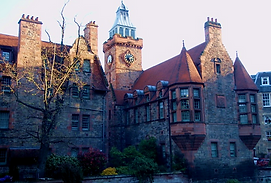
Well Court- Dean Village
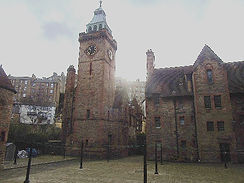
The most impressive buildings are of Well Court. Built in 1884 by the then owner of the Scotsman newspaper
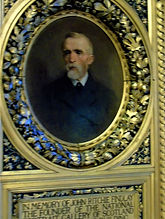
Sir John Ritchie Findlay. Well Court had its own hall for socialising with a clock tower a communal court yard, and accommodation (tenements). For his staff who worked for Sir John at the Scotsman newspaper.
Plaque on Well Court Portrait of Sir John Ritchie Findlay in National Portrait Gallery

Dean Path Footbridge
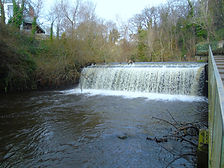
The foot bridge takes you over the Water of Leith to Well Court, Old West Mill and the Village School house. Along the water side 100 metres is a waterfall which was a weir (a low dam) which was used to power the mills. A great variety of wild life.
The Plague
The burgh records mention that the pest was in the Dene On the 15th June 1513 and no one from the area was allowed to enter the walls of Edinburgh. If a women entered she would be branded on the cheek. If a man entered the punishment would be sever even hung.

Merchants House 17 Bells Brae
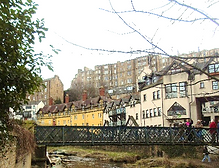
The building on the south west corner of Bell’s Brae Bridge is one of the oldest buildings that still remains from the Water of Leith Village built circa 1650.
17 Bells Brae, was where the head of the local merchants' guild lived who oversaw the village's milling industry. It was also a local shop run by A W Kemp in the 20th century.

The Granary | Old Tollbooth
The Granary was built in 1675 (yellow building in photo) known as the Old Tollbooth Inscribed in two lines
GOD BLESS THE BAXTERS OF EDINBURGH WHO BUILT THIS HOUS 1675. On the cornice is a carved panel with a circular garland, a wheat-sheaf flanked by two cherub's heads another inscription GODS PROVIDENCE IS OUR | INHERITANCE 1677, The Last Mill at Bell's Mills was nearly totally destroyed by an explosion in 1971.

Hawthornbank Lane
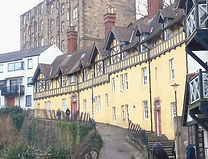
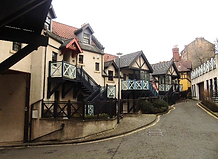
Hawthornbank lane is part of the original milling hamlet known the Dene or Water of Leith Village and was famous as a grain milling area for over 800 years. The name Dene (Dean) meaning Deep Gorge. The Dean Village with the Water of Leith flowing through, grew as a community in the 1100s from the numerous mills that were built on the river banks.
Miller’s Row
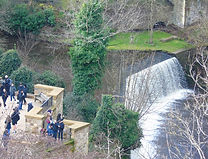
On the pathway towards Leith under the Dean Bridge is an area called Miller’s Row old houses for the mill workers. Also you can see three mill stones resting against each other previously used in the Granaries in the 1600s. Look over the wall to see a waterfall which is another part of the weir
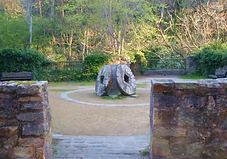
St George's Well
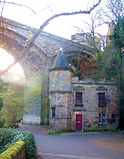
The Water of Leith and the source of the mineral water for St Bernard's Well and St George's Well. St George's Well is on the banks of the Water of Leith near to Alexander Nasmyth's St Bernard's Well. Built in 1810 by Mr MacDonald of Stockbridge on the 50th year on the throne to commemorate the jubilee of George III. King George III celebrated his Golden Jubilee on October 25, 1809, marking the beginning of his 50th year on the throne. It was the first significant jubilee celebration in British history. The well was finally blocked up in 1969.
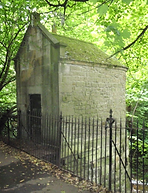
St Bernard's Well
A natural mineral spring was discovered on the Water of Leith near to Stockbridge in 1760, some claimed that the water could cure everything. Francis Garden, Lord Gardenstone of Troup the landowner, commissioned a building in 1789 to be erected over the well Alexander Nasmyth designed a Doric Temple, a copy of the Temple to the Sybil at Tivoli, the summer palace of the Roman emperors. The Temple has a domed ceiling supported by 10 columns which covers the statue of Hygeia, the Greek goddess of health The Well closed in 1940. There are two mineral wells on the Water of Leith one called St Bernard's Well and the other well a short distance west and this is called St George’s Well. This was also to have the same powers as St Bernard’s well but was never used to the extent of St Bernard's well. Hygeia Greek Goddess of Health.
The well named after St Bernard of Clairvaux (1090–1153) a French abbot, theologian, and major leader in the reform of the Cistercian Order which was present over Scotland, in 1136 an invitation of King David I lead to many Abbeys being built. Melrose Abbey: Founded in 1136, was Scotland's first Cistercian monastery. Famously for the place the heart of Robert the Bruce is buried. Also a pig playing bagpipes.
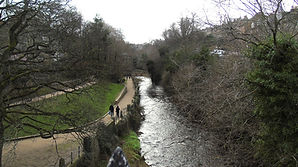


William Nelson Memorial
William Nelson was a publisher in Edinburgh and took it upon himself to renovate the St Bernard’s well as it had become in a state of disrepair. He used his own funds to renovate and improve its aesthetic look.
St Bernard’s Bridge
Also known as Mackenzie Bridge possibly named after Samuel MacKenzie
(portrait painter and pupil of Sir Henry Raeburn). The bridge was Built in 1824.
The steps and added archways were built in 1887, with Edinburgh’s Coat of Arms above the western arch. The small arch was block off in 1890. The view over the Water of Leith east and west and the road from Mackenzie Place to Dean Terrace


The Dene Archway
Water of Leith Walkway.
The Dene to Belford Bridge.
The Dene meaning Deep Gorge was first mentioned in 1143 when David I granted one of his mills of Dene to the Abbey monks of Holyrood. The Dene steps take you to St Bernard’s Bridge built in 1824.
17 Danube Street
The house at 17 Danube Street was once a high class Brothel owned by Dora Noyce, Scotland’s most famous Madam. She was in business circa 1945 until 1977. A well-known face in the Royal Mile making sure the men in the pubs new her address.
She ran a reputable business with well looked after ladies and clients were given the best of attention. Her early days as a call girl she would dress in quality clothes and speak with a high class Edinburgh accent.
(This is where the saying “Fur Coat and Na’ Knickers” came from.
Anne Street
Sir Henry Raeburn designed Ann Street and named after his wife Ann in 1823 by architect James Milne. It was one of the first streets in the New Town to feature private front gardens. He married Ann Leslie (née Edgar), a wealthy widow who own land and property in and around the Water of Leith. No 29 Ann Street was the house of writer Christopher North (John Wilson Edinburgh Lord Provost).
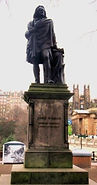
His statue is in East Princes Street Gardens.

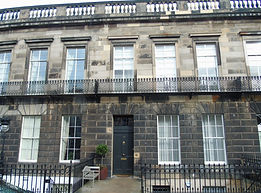

Duncan’s land Stockbridge David Robert’s R.A. Birthplace
Duncan’s land a house built 1790 from rubble from the houses of the Lawnmarket knocked down in development of Bank Street Edinburgh. The initials on the plaque could be of Husband and Wife, a wealthy family of the time. The inscribed lintel is from one of the old town houses.
David Roberts was born on 24th October 1796 son of John Roberts who was shoemaker to trade. David Roberts started his career as a designer and painter and became a stage designer for a circus. His talents grew and he became a very successful stage designer and artist while in his free time he painted with oils and became a renowned artist of buildings and scenery which became a full time vocation by 1830. He travelled the world painting and travelled to Egypt and Syria which was the first time many had seen such scenery and Queen Victoria was so taken with his work purchased the entire collection.


Inscription Lintel Duncan's Land Stockbridge;
This lintel on the building was taken from the rubble of the houses demolished to make way for Bank Street in 1798 Inscription on Lintel I.G. I FEAR GOD ONLYE 1605 I.R.
John Gourlay's House, in the Old Bank Close.
Inscription on plaques on Duncan’s land Stockbridge;
DAVID ROBERTS R.A. | LANDSCAPE PAINTER | WAS BORN HERE ON | 24TH OCTOBER 1796
ERECTED BY THE COCKBURN ASSOCIATION | IN CONJUNCTION WITH
THE ROYAL SCOTTISH ACADEMY

Robert Chambers 1802 - 1871
Robert Chambers at an early age started a business selling old books his brother started a printers and after a while they started a new business together Robert Chambers the writer and William Chambers the printer. There first venture was a periodical The Kaleidoscope a magazine published every two weeks. Robert interested in history published a number of books Traditions of Edinburgh, Walks in Edinburgh, the Life of Walter Scott, and many more on Scottish History.


John Wilson AKA Christopher North
John Wilson a writer, author, advocate and Professor of moral philosophy at the University of Edinburgh. He was most frequently identified by his pseudonym Christopher North. His family home was 29 Ann Street before having to move and live at his mother’s house No 6 Gloucester Place with his family due to almost bankruptcy caused by his uncle’s dishonest speculation with his money. Through hard work he recovered to move his family to their new home in Ann Street where he remained until his death in 1854. His statue stands in East Princes Street Gardens between the mound precinct and the Walter Scott monument.

Moray Place and Forres Street
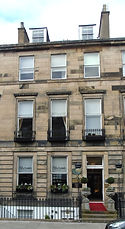
The Moray Estate was designed for the 10th Earl of Moray (1771-1848). He inherited the 13 acre site from his father, after it was acquired from the Heriot Trust in 1782, and decided to feu the property for development in 1822. James Gillespie Graham, designed 1822. The complicated plan, with the crescent, oval and polygon of Randolph Crescent, Ainslie Place and Moray Place respectively, conjoins the New Town with the Second New Town. Building was completed in 1830-31.
Lord Francis Jeffrey lived at No.24 Moray Place
Lord Francis Jeffrey (1773 – 1850) was a literary critic and Scottish judge, Francis Jeffrey was also the editor of the Edinburgh Review a liberal critical periodical from 1803 -1829. He was appointed Lord Advocate, also as a member of the House of Commons he introduced the Scottish Reform Bill in 1831. On the naming of Edinburgh’s streets the connecting from the High Street to Waverley Station was named “Jeffrey Street” in his honour.


Baron David Hume nephew of David Hume philosopher lived at No.37 Moray Place.
David Hume, Baron Hume of Ninewells (1757–1838) was a Scottish advocate and judge. In 1822, he became Baron of Exchequer. When he became Baron David Hume. He wrote many books on Scottish Law of which culminated in his ‘Commentaries on the Law of Scotland, Respecting Trial for Crimes (1797)’, which is still used as a reference in court cases to this day.
David Hume of Ninewells, is buried in Old Calton Cemetery as is his sons and Uncle.

William Graham live at 1 Moray Place
William Graham was a pioneer for secondary education for girls and the principal founder of the Scottish Institution for the education of young Ladies. In 1847 the Educational Institute of Scotland (E.I.S) was set up.
Thomas Chalmers No.3 Forres Street
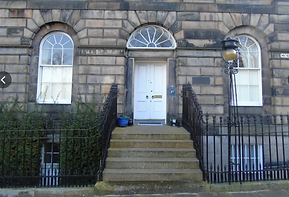
No. 3 Forres Street was the residence of Thomas Chalmers 17 March 1780 – 31 May 1847
His Statue is in George Street Edinburgh. Thomas Chalmers was a Scottish minister,
professor of theology, political economist, and a leader of the Free Church of Scotland.
He has been called, "Scotland's greatest nineteenth-century churchman".
He was highly regarded during his lifetime as a natural theologian.

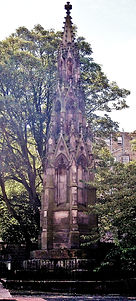
Catherine Sinclair Memorial Replica Scott Monument
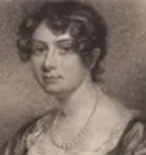
Catherine Sinclair was born in Edinburgh on 17 April 1800.
Her father was Sir John Sinclair, a well-known politician and the first organiser of the Statistical Account of Scotland’. Catherine Sinclair was home educated and published her first book in 1832 (‘Charlie Seymour, or, the good aunt and the bad aunt’). Catherine Sinclair most popular book was for children and was sold worldwide Holiday House published in 1839. She also established cooking depots and was instrumental in drinking fountains and park benches being installed around the Edinburgh streets.
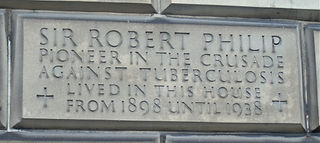
Sir Robert Philip 45 Charlotte Square
Professor Sir Robert Philip opened the world's first tuberculosis dispensary in Bank Street Edinburgh in 1887. Sir (Dr) (Professor) Robert Philip pioneered the management, prevention, detection and treatment of tuberculosis (TB). On the wall in Bank Street a blue Plaque reads “Near this place in 1887, Dr Robert Philip founded a tuberculosis dispensary, the first clinic in the world dedicated to fighting a disease of which he foretold Man’s eventual mastery. That vision has brought hope to many lands.” Tuberculosis (TB) was the biggest killer in the UK by the middle of the 19th century and due to Sir Robert Philip it has been almost eradicated. Sir Robert Philip died at home in 9 Palmerston Road, in the Grange area of Edinburgh, on the 25th January 1939.

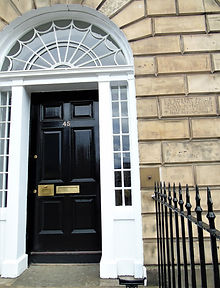
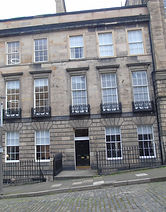
Charlotte Square
A typical terrace of houses built in the new town in the 1796 on the north side of Charlotte Square. The row of terraced houses in Charlotte Square was the city’s most affluent area, with boot scrappers and torch snuffers at the doors the must haves before electric and door mats. Also a stone paving for geting in and out a carraige. This is where the wealth lived in the city whith the country house for weekends.


Charlotte Square Gardens
Charlotte Square was part of the designs of the new town of 1759, originally called George Square after King George III and renamed Charlotte Square after his wife, as there was a George Square already in existence in Edinburgh. The memorial in Charlotte Square Garden is of Prince Albert, husband of Queen Victoria.
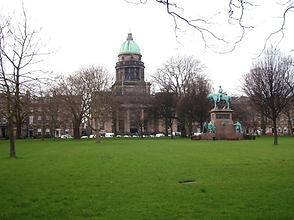
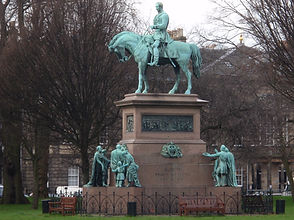
Albert Prince Consort Monument
Albert Francis Charles Augustus Emmanuel of Saxe-Coburg-Gotha was born on 26 August 1819 in Bavaria. He married Queen Victoria in 1840. Albert and Victoria's were cousin. In 1857 he was given the title of Prince Consort. Albert was behind the great exhibition of 1851. Albert and Victoria had 9 children and when Albert died in 1861 at the age of 42.
His wife Queen Victoria went into morning on his death, which lasted until her death in 1901. The monument in the centre of Charlotte Square is a memorial to Albert Prince Consort.
A bronze statue of Prince Albert on a horse. It was unveiled in 1876 by his late wife
Queen Victoria. Sir John Steell the sculptor.
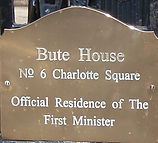
Bute House First Ministers Residence
(No. 6) Charlotte Square Edinburgh
No. 6 Charlotte Square has been the official residence of the First Minister of Scotland since 1999. The First Minister is the equivalent to the UK Prime Minister, if Scotland were to become independent. The house is similar to next door at No.7 and it is believed to be one of the finest examples of Georgian architecture in Edinburgh.
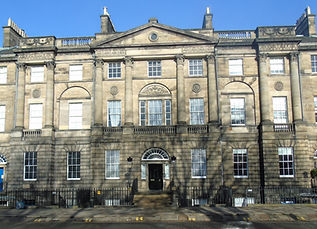
The Georgian House No. 7 Charlotte Square Edinburgh.
Charlotte Square was one of the most fashionable and desirable residential addresses in the New Town. The Georgian House is a fully restored house with furniture of the period and some even older. Built in 1796 by Robert Adam. The 18th Chief of Clan Lamont was the first owner in 1796. The 4th Marquees of Bute purchased the property with others in the row, restoring the
properties to their original Georgian grandeur as you see today. (The real Downton Abbey in Edinburgh).

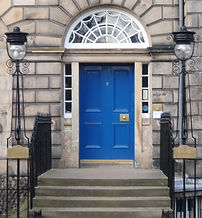
Lord Joseph Lister No. 9 Charlotte Square Edinburgh
Lord Lister lived with his father- in- law James Syme at No. 9 Charlotte Square for 7 years 1870-1877.
Born in Upton Essex he introduced carbolic acid to sterilise surgical instruments. Carbolic Acid is now known as Phenol.
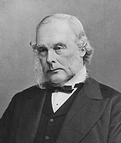

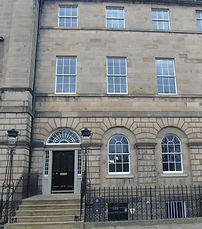
Sir William Fettes 1st Baronet (25 June 1750 – 27 May 1836) No.13 Charlotte Square Edinburgh
Founder of Fettes College. When he was eighteen he went into business as a grocer, trading in wine and tea from Smith’s Land at Bailie Fyfe’s Close in the High Street Edinburgh. He retired from trading Tea and Wine in 1800 to concentrate on his many other investments, after his retirement he moved to No.13 Charlotte Square and this is where he died. School building was designed by David Bryce, and it opened in 1870, 34 years after his death. His tomb is in Canongate graveyard.
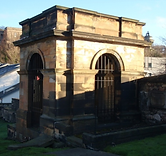


Lord Henry Cockburn (1779-1854) 14 Charlotte Square Edinburgh
Henry Cockburn entered the Faculty of Advocates in 1800 at 21 years of age. Following in the footsteps of his father. He married in 1811 and lived in the new town of Edinburgh (14 Charlotte Square). He also had a country farmhouse in Bonaly at the foot of the Pentland Hills. He had 10 children. In 1834 he became a Judge in the Court of Session. And also became Solicitor General for Scotland and Lord Cockburn. A great conservationist protecting Edinburgh’s old buildings for the benefit of Edinburgh. He was happily married for over 40 years and died at Bonaly on 26 April 1854 and is buried in the Dean Cemetery. After his death in 1875 The Cockburn Association was founded and named in his honour. The first major campaign by the Association was to resist the removal of trees at Bruntsfield Links and the Cockburn has campaigned for the retention and improvement of Edinburgh's open and green spaces ever since.
Lord Henry Cockburn Lived at 14 Charlotte Square Edinburgh from 1813 -1848. Lord Henry Cockburn’s acquaintances were Lord Francis Jeffrey, Sir Walter Scott all members of the Speculative Society founded in 1764 and still meets at the Old College of Edinburgh University.
Bonaly Tower Edinburgh was the country residence of Lord Cockburn. This building was originally purchased as a farm house circa 1810. Lord Henry Cockburn a wealthy Advocate of Edinburgh (became a Lord in 1834) over time had the farmhouse extended with a peel tower added, designed by William Playfair in 1839, the west wing by David Bruce in 1870 and later a library was added in 1888, where the original farmhouse had stood.


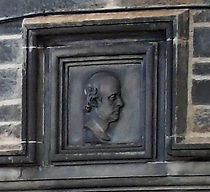
The church of St George / West Register House
West Register House was built as part of the new town plans, having a Square at each end of the plans with a church looking over a garden square. This did not go ahead in St Andrew Square as there was no land space available to build a Church to mirror the one in Charlotte Square. The church of St George was built in Charlotte Square between 1811 and finished in 1813 and opened in 1814 which was to hold up to 1500 worshipers with a dome said to replicate the dome of St Paul's in London. In 1964 St George's church united with St Andrew's Church in George Street and later that year the National registers moved in and it became West Register House.


Earl Douglas Haig (No.24) Charlotte Square Edinburgh.
Douglas Haig son of the Haig Whisky family and became a Field Marshal in the British Army in the First World War. He also served in India and in Africa in the Boer War. He led his forces in the Battle of the Somme and was nicknamed,The Butcher of the Somme due to his tactics. He died in London in 1928 and was buried in Dryburgh Abbey in the Borders.
Born in Edinburgh (No.24) Charlotte Square Edinburgh.
THe Statue on Horseback is in Edinburgh Castle


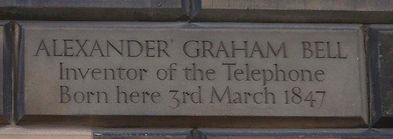
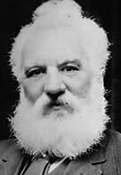
Alexander Graham Bell (No.16) South Charlotte Street Edinburgh
Alexander Graham Bell was a scientist, inventor, engineer and innovator. He was the inventor of the first practical telephone. He was born in Edinburgh on 3 March 1847 and his home was at 16 South Charlotte Street. The door is now 14 but above on the stone work 16 can still be seen. There is now a commemorative wall tablet beside the door marking where he was born. He was educated at University of Edinburgh and University College London. He died of diabetes on 2 August 1922 (aged 75) in Nova Scotia, Canada. Alexander Graham Bell was awarded the first US patent for the telephone in 1876. Bell considered his most famous invention an intrusion on his real work as a scientist and refused to have a telephone in his study.

Visit (Free Entry)
Scottish National Gallery of Modern Art I
Scottish National Gallery of Modern Art 2
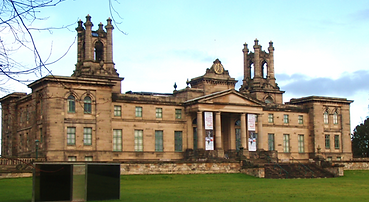

More Places to visit in the Dean Area
Views of
Sunbury + Belford Mews + Belford Bridge
Daniel Stewarts


