

Attractions de Cowgate
Edinbourg
Cowgate Grassmarket Edinburgh était la route menant à Edimbourg par l'est. auparavant le sud du Loch avant drainé vers 1300. Nommé d'après la porte du mur de Flodden qui entourait Édimbourg. La porte était la façon dont les agriculteurs apportaient leur bétail (vache) au marché. Par la porte des vaches du mur de la ville (Flodden Wall). Aujourd'hui, c'est la plaque tournante des pubs, des restaurants, des clubs, à distance de marche de toutes les attractions, des sites historiques, du Royal Mile et du château d'Édimbourg. Il y a des endroits qui existent encore dans le Cowgate depuis l'histoire d'Édimbourg ; La chapelle de la Madeleine, James Connolly Lieu de naissance, L'église St Patrick, l'une des écoles de George Heriot, Tailors Hall, le premier pont pour spa le Cowgate (South Bridge), les voûtes créées par le pont qui servaient autrefois de magasins L'histoire d'Édimbourg est vaste et j'espère avoir donné un bon compte sur ce site.


Cowgate Port + St Mary’s Port
St Mary’s Port across the Pleasance from Heriot’s Hospital to a building at the head of Back of Canongate South (now Holyrood Road). Cowgate Port across the Cowgate from Heriot’s Hospital to buildings on North of Cowgate.


Hôpital Heriot (école)
Cowgate Edimbourg
L'hôpital Heriot (école) Cowgate se trouvait dans un bâtiment au coin de Cowgate et Pleasance à Édimbourg. Il a été construit après que le mur et le port de Cowgate ont été enlevés pour le développement et il est possible que la pierre du mur ait été utilisée pour construire l'hôpital (école). Ce bâtiment est toujours debout à l'origine construit entre 1838 -1840 le cadran de l'horloge a une date de 1840 et sur le devant du bâtiment se trouve une inscription George Heriot's | Hôpital | École | 1838 C'est l'une des sept écoles ouvertes par les gouverneurs de l'école d'Heriot pour éduquer les enfants pauvres de la ville.


RC Saint-Patrick
Cowgate Edimbourg
St Patrick's Edinburgh a été construit en 1774. Il était d'abord presbytérien puis épiscopal et finalement en 1856, il a ouvert ses portes en tant qu'église catholique pour servir la communauté irlandaise croissante à Edimbourg. Il a été rapporté qu'il y avait 2600 assister au premier service. En 1869 le chanoine Edward Hannan a créé la Catholic Young Men's Society (CYMS) et a créé une équipe de football pour aider la communauté catholique irlandaise d'Édimbourg Southside se mêle à la plus grande communauté catholique d'Édimbourg. Il a été décidé après le rejet de nombreux noms différents que le club de football devrait être nommé Hibernian d'après le nom romain de Irlande. Depuis lors, le Hibernian Football Club fait partie de l'histoire sportive d'Édimbourg.

Plaque du Cardinal Beaton
Cowgate Edimbourg
David Beaton est né en 1494 et mort en 1546. Le 20 décembre 1539, David Beaton a été nommé cardinal par le pape Paul III. Le cardinal Beaton est devenu régent de Marie, reine d'Écosse et s'est nommé chancelier d'Écosse en 1543. Il était détesté par la plupart, mais était en faveur de la royauté de France et de Grande-Bretagne. Il a eu de nombreuses maîtresses et 20 enfants illégitimes. Il a été arrêté pour fraude et la cause de la courtoisie brutale, l'invasion de l'Écosse par Henri VIII.

Plaque du Cardinal Beaton
Cowgate Edimbourg
David Beaton est né en 1494 et mort en 1546. Le 20 décembre 1539, David Beaton a été nommé cardinal par le pape Paul III. Le cardinal Beaton est devenu régent de Marie, reine d'Écosse et s'est nommé chancelier d'Écosse en 1543. Il était détesté par la plupart, mais était en faveur de la royauté de France et de Grande-Bretagne. Il a eu de nombreuses maîtresses et 20 enfants illégitimes. Il a été arrêté pour fraude et la cause de la courtoisie brutale, l'invasion de l'Écosse par Henri VIII.


Première presse à imprimer
Chevalier noir
Cette plaque fait don de l'endroit où a eu lieu la première impression d'un livre en Écosse. Les imprimeurs Walter Chepman et Andrew Myllar ont imprimé le premier livre en 1508 après avoir obtenu une licence du roi (James IV) un an plus tôt.
Les imprimeurs se tenaient dans le Cowgate au pied de Blackfriars Street près de la maison du cardinal Beaton.

Plaque Robert Louis Stevenson
Cowgate Edimbourg
« Regarder par-dessus le South Bridge et voir le Cowgate en dessous plein de colporteurs en pleurs, c'est voir un rang de la société de la mère en un clin d'œil ». Robert Louis Stevenson 1878. La plaque se trouve sur le mur de les Rowantree a Venue dans le Cowgate, Edinburgh EH1 1NN près du South Bridge.

South Bridge
Bridges over Cowgate
The South Bridge was constructed circa 1788, due to the ground and valleys the bridge was constructed with
19 arches. The arch that spans the Cowgate is the only one that is visible. Underground can be seen vaults that were made due to the bridge. The vaults were occupied by tradesmen, shops and taverns the first underground shopping mall. Due to the conditions of the vaults with lack of light and air, the vaults were soon abandoned.
Cowgate to St Mary’s Street Cowgate to George IV Bridge


Underground Vaults
The South Bridge was constructed circa 1788 due to the ground and valleys the bridge was constructed with 19 arches. The arch that spans the Cowgate is the only one that is visible. Underground can be seen vaults that were made due to the bridge. The vaults were occupied by tradesmen, shops and taverns the first underground shopping mall. This did not last due to the conditions of the vaults with lack of light and air, the vaults were soon abandoned. It is not known when the vaults complex was closed down, with some suggesting as early as c. 1835 and others as late as c. 1875. Written records regarding the vaults during their slum use are virtually non-existent. There are areas within The Caves that are the building remains of what was Adam Square, which was demolished to make way for the erection of the South Bridge. The original terracotta floor tiles, a hearth stone, and what remains of a fireplace, were found in one of the rooms within The Caves whilst it was being excavated. In another room, within The Caves, a well was found. South Bridge started in 1785, when the 19 arches to support it were built. The vaults, chambers and tunnels underneath it were walled in and sectioned off the descending levels. By 1788, when South Bridge was officially opened, approximately 120 vaults, or rooms, were ready.

Blair Street
Blair Street was formed when the South Bridge was being built in 1768. To give access to the Cowgate from the High Street, at that time Marlin’s Wynd and Pebble's Wynd were demolished in 1785 with the west side of Niddry Street. Blair Street as Hunter Square was named after Lord Provost Sir James Hunter Blair.
Marlin’s (Merlyoune) Wynd
Marlin’s Wynd is below the level of the present streets as Mary King’s Close is. Marlin’s Wynd was to the west of the Tron Kirk and ran down to the Cowgate. Named after John Merlyoune (Marlin), who was in charge of paving the High Street. He requested in memory of his work that he would be buried underneath the paving stones. He was buried at the head of the Wynd (which was named after him) by paving stones in the shape of a grave. Other writings mention that the High Street was paved in 1532 by two brothers John and Bartoulme Foliot.
Also a John Merlyoune was first to pave Marlin's Wynd 1542.

Free Cowgate Church (Stramash)
Church built in 1859, was built by Edinburgh architect Patrick Wilson.
The panel above the door reads;
'Erected and endowed from funds bequeathed by William Whyte Edinburgh MDCCCLXI’.

Guthrie Street | College Wynd
Guthrie Street was built to replace College Wynd and was named after Dr Thomas Guthrie the founder of the first Ragged School in 1841, which can be seen in Ramsay Lane of Castlehill Royal Mile Edinburgh. Guthrie Street is a link between Chambers Street and the Cowgate Edinburgh. There are steps from Chamber Street to Guthrie Street which was previously West College Street before Chamber Street was built.
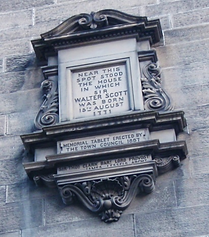
Walter Scott was born in College Wynd which was demolished and replaced with modern housing. The plaque can be seen on the wall at the corner of Guthrie Street and Chambers Street is to signify the location of the house where Sir Walter Scott was born in August 1771. Walter Scott's Birthplace Stone Guthrie Street Edinburgh


Old Fishmarket Close Swift’s Wynd Carmichael's Close
The Fish market was one of the casualties of the Great 1824 fire as it was destroyed. This close was originally known as Swift's Wynd a narrow street joining the Cowgate to High Street, the name recorded as far back as 1539. Alexander Swift owned a cellar at the head of the close and John Swift, a tenement. It then became Carmichael's Close in 1722 after Mr William Carmichael, advocate that lived there with his family. It was later renamed Fishmarket Close due to the fish market that was once active there. George Heriot known as “Jinglin’ Geordie”, the kings Jeweller and the founder of George Heriot’s Hospital (school), also lived in the close.
This was also a close that housed the first firefighting appliance.
At the foot of the Close on the west side was a property that was provided by the Council for the executioner. This gave the executioner easy access to both the Lawnmarket and Grassmarket place of Execution by hanging or beheading. The house also provided a prison room for the condemned on the night before their demise.


salle des tailleurs
Cowgate Edimbourg
L'incorporation des tailleurs des archives de Canongate remonte à 1438 (archives nationales d'Écosse). L'incorporation des tailleurs a acheté un terrain à Cowgate en 1620. Le site était l'endroit où ils ont construit leur salle de réunion qui a été achevée l'année suivante. En février 1638, un projet de copie du Pacte national fut approuvé dans la salle du tailleur. Le bâtiment a été agrandi en 1757 par un étage supérieur. Les bâtiments sont maintenant un bar et un logement. Le Pacte national a d'abord été signé au cimetière Greyfriars d'Édimbourg le 28 février 1638 avant de parcourir le pays pour les signatures.

Ponts enjambant
Cowgate Edimbourg
Les 2 ponts qui enjambent le Cowgate à Édimbourg ont été construits pour permettre l'accès au sud d'Édimbourg. Le pont sud a été achevé en 1788 et était une extension du pont nord et traversait la rue principale au niveau de Tron Kirk qui a longtemps été le marqueur central du vieil Édimbourg. Le pont George IV a été achevé en 1832, ce qui a commencé à partir du Lawnmarket et était une continuation de la rue Bank et du monticule. De nombreuses maisons et clôtures ont été démolies pour faire place aux ponts afin de permettre des liaisons faciles avec le sud d'Édimbourg. Les bureaux de la Compagnie des Marchands de Edinbourg était l'endroit où se trouve maintenant l'arche du pont George IV. C'est là que la première école de dames a été créée par un don de Mary Erskine en 1694 , connu sous le nom de Merchant Maiden Hospital .


James Connolly Birthplace
James Connolly was born in Edinburgh at 107 Cowgate on 5 June 1868. The first time he stood on Irish soil was as a British soldier at the age of fourteen. He was the secretary of the Scottish Socialist Federation in 1892 aged 24.
He also founded the Irish Socialist Republican Party whose aims were to secure the national and economic freedom of the Irish people. He started a weekly newspaper, the Workers’ Republic and the first publication was issued in August of 1898. At the age of 46 in 1914 he became Acting General Secretary of Irish Transport and General Workers Union. He formed an Anti-War Committee and as the leader he Committed the Labour movement to oppose recruitment and conscription to the British Army ‘we serve neither King nor Kaiser, but Ireland’. When the Secret military council of the I.R.B. Decided on an armed rising in 1916, Connolly took part in the preparations and in 1916 he had become convinced that a nationalist revolution was the only way to free Ireland from what he saw as imperial and capitalist oppression. He was sentenced to death for his part in the uprising and was executed in Kilmainham Jail Dublin 12 May 1916.


Merchants of Edinburgh – Merchant Maidens Hospital
Merchant Company of Edinburgh
The Merchant Company of Edinburgh was established in 1681. The previous name was the Guidry before it became a society. Their first meeting hall was in the Cowgate Edinburgh and they then moved to Hunter Square before moving to its final home of Hanover Street. The Merchant Company was a watch dog for Edinburgh looking after the concerns and needs of the people. Over time the wealthy would leave their estates to be administered by the Merchant Company by way of a trust. This resulted in with well-judged investments the Merchant Company become the largest land owners in Scotland. The Merchant Company in 1694 with a donation from Mary Erskine a widow, which established Mary Erskine School. With other donations and bequests and trusts, further education facilities were opened, George Watson’s College in 1741, George Watson was an accountant, and merchant banker and the first accountant of the Bank of Scotland, James Gillespie’s High School in 1803, James Gillespie was a local Tobacconist in the High Street Edinburgh and Daniel Stewart held an appointment in the Court of Exchequer, Daniel Stewart’s College in 1855 which is now ESMS (Erskine, Stewart, Melville Schools). John Watson’s School in built in 1828 at 75 Belford Road next to the Dean Cemetery. The Edinburgh Chamber of Commerce was established as an off shoot of the Merchant’s Society of Edinburgh in 1786.
Magdalen Chapel Cowgate
The Magdalen Chapel was built by Michael Macquhane and his wife Michael died in 1537 and his wife managed the completion of the chapel in 1542. The Magdalen Chapel was a chapel and Hospital for the poor. The Incorporation of Hammermen took over the running of the building in 1547. On the plaque above the door show their initials MM. JR. and the date of Janet Rynd's death 1553. The Chapel was a place of worship and also the guild Hall for the incorporation of Hammermen. The Hammermen were metal workers and tradesmen who became the trustees of the Chapel and attached building a hospital, which is now a hostel. Inside the Chapel is an amazing stain glass window which features the Royal Arms of Scotland, the Arms of Mary of Guise, Mary Queen of Scots. mother Also still in the Chapel is the Deacon of the Hammermen's Guild of Edinburgh chair which was made in 1708. There are many other artefacts from Scottish history on display in the Chapel please arrange a visit as there is much to see.

Medical Missionary Society | Livingstone House
Edinburgh Medical Missionary Society moved into 39 Cowgate in 1858 which was then owned by the Scottish Reformation Society. The EMMS (Edinburgh Medical Missionary Society and Livingstone Institute) rebuilt in 1877 and operated a dispensary for the local people. The building occupied from the corner of Candlemakers' Row to the Magdalen Chapel. Above the entrance on the corner are 13 carved heads. The building housed a dispensary, waiting rooms, lecture theatre, students' bedrooms (the Livingston Residence), a working men's club and 3 shops.

Grapes

Frog

Plums

Knight’s Templar


Thistle

Acorns

English Rose

Devil


Cowgatehead Free Church
The Gothic church was founded in 1861 with money from William Whyte’s will. William Whyte bookseller to the Queen Dowager Adelaide wife of William IV. The stone panel on the tower above the door reads; 'Erected and endowed from funds bequeathed by William Whyte Edinburgh MDCCCLXI
