

Princes Street Edimburgo
Attrazioni e Storia
Attrazioni di Princes Street Edimburgo
La famosa strada di Edimburgo “Princes Street” originariamente chiamata St. Giles Street in onore del santo patrono della città, Saint Giles.
Re Giorgio III, dopo aver riflettuto, rifiutò il nome St. Giles Street poiché St Giles era il santo patrono dei lebbrosi e anche
il nome di una baraccopoli ai margini della City di Londra. E 'stato ribattezzato Princes Street dopo i suoi figli, i Principi.
Princes Street è lunga circa 2 km con negozi sul lato nord e giardini sul lato sud della strada.

Il Nor Loch
(Giardini di Princes Street)
Il Nor Loch si estendeva da sotto il North Bridge, dove ora si trova la stazione di Waverley, e ad ovest ai margini di
Chiesa di San Cuthbert, il Castle Rock e le Scuderie del Re Strada. Il prosciugamento del Nor Loch era necessario a causa del fatto che era stato fortemente inquinato da secoli di liquami drenanti a valle del Centro Storico. Il prosciugamento del Nor Loch iniziò nel 1759 creando un canale che sfociava nel Lochend alle spalle di Calton Hill. I giardini sono stati creati nel 1820. Nel 1840 fu costruita la ferrovia nella valle e Waverley Station aprì nella sua forma attuale nel 1854, il nome originale era Canal Street Station poiché il canale la attraversava.


Giardini di Princes Street
Princes Street Gardens è un parco pubblico nel centro di Edimburgo, all'ombra del Castello di Edimburgo. Prima che i giardini si formassero un Loch (lago) circondava la Rocca del Castello. A separare i due Giardini Ovest ed Est c'è il Tumulo che si formò da terra e macerie quando la nuova città era in costruzione, divenne un collegamento tra la Vecchia e la Nuova Edimburgo.
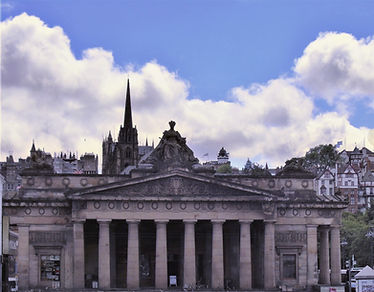
Royal Scottish Academy of Art Mound Edimburgo
La più antica e prestigiosa accademia di arte contemporanea in Scozia. L'Accademia è attiva nella promozione di giovani artisti provenienti dai College of Art and Architecture scozzesi e assume un ruolo guida nella promozione degli artisti viventi in Scozia. Royal Scottish Academy visto con l'ingresso da Princes Street Edinburgh.

Dean Ramsay Cross
Dean Ramsay è stato un sacerdote a St John's per 45 anni. La croce celtica in sua memoria può essere vista all'estremità orientale della chiesa vicino all'ingresso dei giardini di Princes Street a Edimburgo.
Dean Ramsay Cross
Dean Ramsay è stato un sacerdote a St John's per 45 anni. La croce celtica in sua memoria può essere vista all'estremità orientale della chiesa vicino all'ingresso dei giardini di Princes Street a Edimburgo.


Anne Rutherford
(Signora Walter Scott Esq)
1733 - 1819
Anne Rutherford nacque nel 1733 e morì nel 1819 la sua tomba può essere vista sul lato est della chiesa di St John, all'estremità occidentale di Edimburgo. Suo padre era John Rutherford e sua madre Jean Swinton. La famiglia Swinton è una delle famiglie più antiche della Scozia. Anne Rutherford era la madre di Sir Walter Scott, il suo nono figlio, sei dei quali morirono durante l'infanzia.
La nonna di Sir Walter Scott era una Halliburton che diede alla famiglia Scott il diritto ereditario di essere sepolta nell'Abbazia di Dryburgh. Dove è sepolto Walter Scott con i membri della famiglia.


Sir Henry Raeburn RA
1756 -1823
Sir Henry Raeburn RA nacque a Edimburgo nel 1756 e divenne il principale ritrattista scozzese. Viveva nella zona di Stockbridge a nord di Edimburgo. Il suo studio Raeburn House dove ha lavorato è a York Place Edinburgh, un'estensione di Queen Street, che era una parte originale della nuova città di Edimburgo. Fu nominato cavaliere nel 1822 e fu ritrattista di re Giorgio IV. Il suo lavoro può essere visto nella Scottish National Portrait Gallery e sulla parete esterna della Galleria si trova una statua di Sir Henry Raeburn tra le altre. Una lapide si trova nella chiesa di San Giovanni all'estremità occidentale di Princes Street, vicino alla tomba della madre di Sir Walter Scott.

George Burnett 1822 -1890
La tomba di George Burnett Lyon King of Arms si trova nel cimitero di St John's all'estremità occidentale di Princes Street Edinburgh. George nacque nel 1822 figlio di John Burnett, quinto Laird di Kemnay Inverurie. La casa di famiglia Kemnay House sarebbe passata ad Alessandro VI Laird, il fratello maggiore di George.
George divenne avvocato nel 1845, membro della facoltà di avvocati e fu nominato Lord Lyon King of Arms nel 1866. Rimase in posizione fino alla sua morte nel 1890. Lord Lyon King of Arms è il più giovane dei Grandi Ufficiali di Stato in Scozia ed è il funzionario scozzese responsabile della regolamentazione dell'araldica in quel paese.


George Burnett 1822 -1890
La tomba di George Burnett Lyon King of Arms si trova nel cimitero di St John's all'estremità occidentale di Princes Street Edinburgh. George nacque nel 1822 figlio di John Burnett, quinto Laird di Kemnay Inverurie. La casa di famiglia Kemnay House sarebbe passata ad Alessandro VI Laird, il fratello maggiore di George.
George divenne avvocato nel 1845, membro della facoltà di avvocati e fu nominato Lord Lyon King of Arms nel 1866. Rimase in posizione fino alla sua morte nel 1890. Lord Lyon King of Arms è il più giovane dei Grandi Ufficiali di Stato in Scozia ed è il funzionario scozzese responsabile della regolamentazione dell'araldica in quel paese.
Johnnie Walker
Centro visitatori
Vecchio orologio
1962 L'orologio all'angolo tra Princes Street e Hope Street è stato eretto nel 1962 e due volte ogni ora i Pipers in miniatura hanno circondato la base dell'orologio suonando la melodia Scotland the Brave. Questo era originariamente un grande magazzino Binns costruito nel 1935 per un'azienda fondata a Sunderland nel 1811 da un commerciante di tessuti chiamato George Binns.

128 Princes Street Edinburgh
Originally built in 1866. The design a grand Italian Palazzo style by
Peddie and Kinnear Architects originally built as the University Club, a private gentlemen's club. With Corinthian columns and a bow window on the first floor.


123 Princes Street
Originally built as a townhouse, in 1869 and in 1873 the exterior of the building was finished in a grand Victorian style

112 Princes Street
The building at 112 Princes Street in Edinburgh was built between 1882 and 1884. It officially opened on 1 February 1884 as the purpose-built clubhouse for the Edinburgh Conservative Club. This building housed the Gladstone Memorial Library on the first floor.
-
In 1978 112 -109 were joined inside to make one large store on the upper floors when completed Debenhams opened in 1981 in May 2021 Debenhams store closed.

100 Princes Street
Originally built as a town house for Lady Mary Clerk of Penicuik in 1798 after her husband’s death. In 1877 it became Dejay's Hotel opened by a Frenchman Calixte Dejay in 1879 it was purchased by Albert Thiem of German heritage naming it the Windsor Hotel. It then was purchased by the over-seas League and opened as
The Royal Over-Seas League Edinburgh’s first mixed-gender
private members' club.

90 Prince Street
Originally a town house built circa 1780 where wealthy families lived. In 1866 A jeweller purchased the retail unit on the ground floor and opened his newly founded business in Princes Street the Jeweller being James Hamilton and his nephew, Robert Inches (who was knighted in 1915). In 1887 with success more space was required and they purchase r premises at No 88. combining the stores. They then purchased 87 George Street and moved in 1952 and still remain. The upper residential floors of 90 was a Turkish Baths from 1861 until circa 1920.

61 -62 Prince Street
Originally built in 1780 as a town house residence Romanes and Paterson moved here in 1884 after the building was redesigned in 1870 to what you see today.

109 - 110 Princes Street
It was built between 1770 - 1800 as private residences. In 1869
it was replaced with a new building as the luxury The Grand Palace Hotel. It then became the Scottish Liberal Club in 1890 and housed
the Gladstone Memorial Library including bust of William Gladstone ) on the first floor. In 2023 The Gladstone Memorial Library, was sold by the Debenhams an is now located in Church Lane, Hawarden, Flintshire, CH5 3DF (North Wales, roughly 6 miles from Chester).

97 - 98 Princes Street
-
Built in 1786 designed by James Craig a three-story and attic stone building on the corner of Princes Street and Frederick street with a main entrance hall and reception areas to welcome their visitors. This was the first tenements (based on a large Town House) of the new town and one of the only that still remain. The ground floor area was converted into a retail unit circa 1840.
-
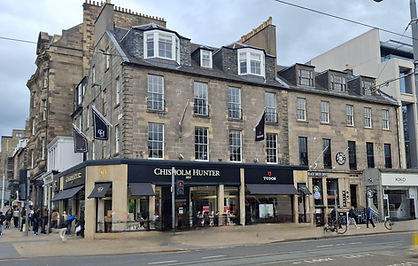
70 -71 Prince Street
The original area was built as a town house by James Craig circa 1780. With its first resident Scottish legal writer and inventor John Clerk of Eldin who lived here with his family until his death in 1812.
The future transformed town house into mixed use, with shops on the ground and basements this town house was demolished and rebuilt as you see it know as the Edinburgh Café built in 1887 in the North European Renaissance style. The Edinburgh Café was sold and changed into mixed use ground floor retail and upper residential. In 1922 D. S. Crawford redesigned the building into
Crawford’s Tea Rooms (the place to be seen).

60 Princes Street
John Dickson & Son Scottish Gun and Rifle maker opened in 1838 closed 1923. The Building was rebuilt in 1903 to what it is today, A Jacobean styled town house built for the owners Turnbull & Co retailers Opticians and Sporting Goods
(fishing equipment).
They moved in 1929 to 37 George Street.
In 1930 J Woodhouse & Son A furniture and household goods store was here until 1960. The Upper floors were used as a Studio and occupied by a number of Photographers over many years

John Menzies
61 Princes Street
John Menzies si trasferì da Londra a Edimburgo all'età di 25 anni e aprì una libreria nel 1833 al 61 di Princes Street, Edimburgo. Con in pochi anni divenne quella che oggi è conosciuta come edicola, essendo la prima a vendere il quotidiano The Scotsman
(un'altra attività ancora in commercio) al banco. John Menzies ora è Menzies Aviation e sta ancora andando forte.
Scopri chi viveva a Princes Street e dove è stato costruito.
Il grande magazzino di Jenner
(uno dei primi grandi magazzini al mondo)
Il negozio originale fu aperto nel 1838 da 2 drappieri disoccupati Charles Jenner e Charles Kennington al 47 di Princes Street.
Il negozio è cresciuto con la sua popolarità di prodotti di pregio e nel tempo ha acquisito altri 2 locali in Princes Street e 8 in
South St David Street per renderlo il più grande grande magazzino del Regno Unito. All'inizio degli anni 1860, quando Charles Kennington si ritirò, Charles Jenner divenne l'unico proprietario. Il negozio fu raso al suolo e ricostruito nel 1893 dallo stesso architetto che progettò il North British Railway Hotel (The Balmoral). La riapertura di Jenner's è avvenuta nel 1895 e ha avuto successo come grande magazzino indipendente fino a quando il gruppo House of Fraser ha assunto nel 2005. Non sorprende che il Royal Warrant sia stato assegnato al negozio nel 1911 poiché i Royals all'epoca erano clienti abituali


43 (No.42 - 46) Prince Street
As building from the 1770's this block were town houses until 1883 one of the only survivors. In 1800 it changed to commercial on the (ground floor) and offices above. In 1848 No. 43 was Scotland's first temperance Hotel. (Waverley Hotel) Owned by the Cranston family until 1953. It Became the Old Waverley Hotel in 1868 as the Cranston's' opened a further hotel the
New Waverley Hotel. In 1883 No.42 - 46 were demolished to what you see today.
La sfera armillare di Forsyth
Princes Street Edinburgh Primo edificio con struttura in acciaio in Scozia. Un'icona dello skyline di Edimburgo da oltre cento anni. Questo edificio ad angolo è stato il primo ad essere costruito con una struttura completamente in acciaio in Scozia, datata 1906. Il negozio all'angolo presenta la Sfera armillare di Forsyth che ha i segni dello zodiaco intorno al centro con 3 figure di putti dorati che tengono la sfera in posizione.


20 Prince Street
No. 19 and No. 20 were rebuilt in 1837 Victorian Town Houses The Royal British Hotel was later Built on the site in 1899

Hotel North British Station
(L'hotel Balmoral)
Edimburgo
Il North British Station Hotel (The Balmoral) è stato aperto per affari nel 1902 ed è posizionato vicino alla stazione di Waverley, tra Waverley Bridge e il North Bridge, che dà accesso diretto al centro storico di Edimburgo, al Royal Mile, al Castello e al Palazzo di Holyrood Casa (palazzo di Holyrood). Direttamente dietro l'hotel si trova Calton Hill. L'Hotel si trova all'estremità orientale di Princes Street, una delle strade più famose e pittoresche del mondo. L'orologio è stato storicamente regolato 5 minuti prima, dando ai viaggiatori in treno l'illusione di essere in ritardo per il loro treno. Il sito su cui sorge è dove sorgeva il primo hotel di Edimburgo. Il primo hotel è stato The Crown nel 1811 e poi cambiato in Royal Eagle e Prince Regent prima di essere demolito per far posto alla modernizzazione e alla costruzione dell'attuale hotel.

Il centro commerciale Waverley di Edimburgo e la stazione ferroviaria di Waverley
L'ingresso della stazione ferroviaria di Waverley in Princes Street è uno dei 4 ingressi della stazione ferroviaria di Waverley, che si trova al di sotto del livello stradale. La Stazione è stata costruita nel 1854 ed è la principale stazione ferroviaria di Edimburgo dove si può viaggiare in tutte le direzioni con una linea diretta per Londra con un tempo di percorrenza di poco più di 4 ore. Ci sono treni per Highlands, Glasgow, gli Scottish Borders, tutti punti a nord ea sud.


Giardini di Princes Street
Princes Street Gardens è un parco pubblico nel centro di Edimburgo, all'ombra del Castello di Edimburgo. Prima che i giardini si formassero un Loch (lago) circondava la Rocca del Castello. A separare i due Giardini Ovest ed Est c'è il Tumulo che si formò da terra e macerie quando la nuova città era in costruzione, divenne un collegamento tra la Vecchia e la Nuova Edimburgo.
Registrati House Princes Street Edimburgo
Register House si trova ai piedi del North Bridge di Edimburgo, costruito su ciò che era all'epoca chiamato Multrees Hill.
Fu aperto nel 1790 e la New Register House sul lato ovest dell'edificio in West Register Street fu completata nel 1858. Gli edifici erano costruito per archiviare i registri anagrafici (nascite, decessi e matrimoni) ed è anche il luogo in cui è ora ospitato il registro Tartan. Direttamente fuori dalla Register House si trova la statua del Duca di Wellington, eretta nel 1852 in memoria della battaglia di Waterloo. Waterloo Place che porta a Calton Hill è anche chiamato in memoria della battaglia di Waterloo che ebbe luogo nel 1815.


Statua del duca di Wellington Princes Street Edimburgo
Direttamente fuori dalla Register House si trova la statua del Duca di Wellington, eretta nel 1852 in memoria della battaglia di Waterloo. Waterloo Place che porta a Calton Hill è anche chiamato in memoria della battaglia di Waterloo avvenuta nel 1815. Il nome del cavallo eretto nel 1852. Il cavallo si chiamava Copenaghen.

Orologio Ritchie
Circolo di Edimburgo
L'orologio che si trova sul lato ovest della statua di Wellington è un orologio che faceva parte del "Edinburgh Circle", un numero di orologi elettronici collocati in giro per la città da Frederick James Ritchie per dare l'ora corretta ai residenti di Edimburgo.
