

Calton Hill Walking Tour
Calton Hill Sumit
Climb the steps and short path to the top of Calton Hill from Waterloo Place and you will see views of Scotland for up to 100 miles on a clear day. To the east, west and north you can see the River Forth and the famous red Forth Rail Bridge and the many islands in the Firth of Forth. This includes the Bass Rock, named by David Attenborough as 'one of the 12 wildlife wonders of the world'.
To the east Berwick Law, a 613-foot (187 m) volcanic hill
(which is worth a climb). Looking over to Arthur Seat and Salisbury Crags below you can see Holyrood Abbey, Holyrood Palace, Scottish Parliament Building and Our Dynamic Earth. Just over the road you can see the memorial to Robert Burns and an enormous obelisk which remembers the political martyrs of 1793, who were banished for sedition and lived the remainder of their lives in Australia. The Nelson Monument (built in 1807) in the form of an upturned telescope can be climbed by the 143 spiral stairs to the top. It is well worth the climb just for the view. Edinburgh’s National Monument referred to as "The Athens of the North"
(a replica of the Parthenon), the unfinished monument is to commemorate victims of the Napoleonic Wars. The project was started in 1826 and, as you can see, is still not finished.
Calton Hill Walking Tour
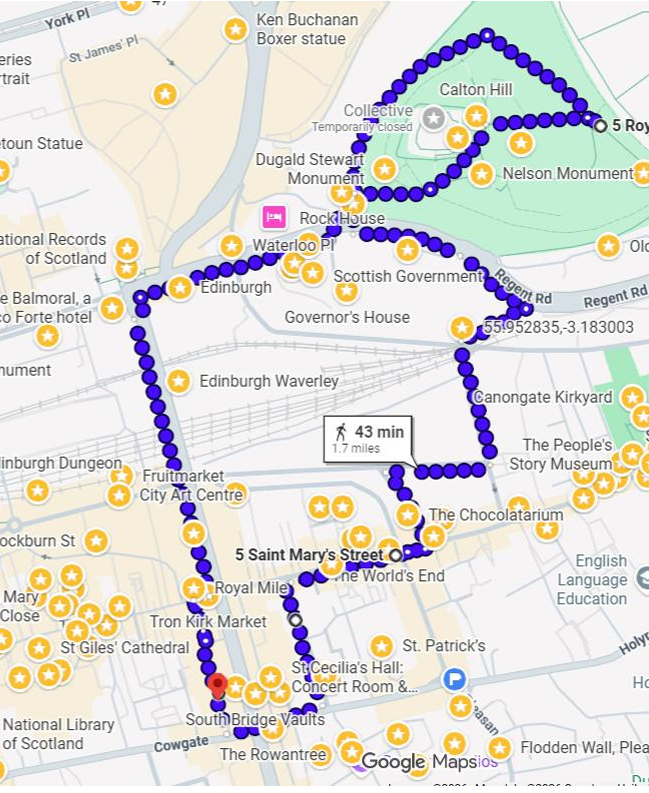
The route of the tour takes you from Tron Kirk in the High Street to Worlds End where the gates to Edinburgh once stood. On the way you will see Old Graveyard with a famous statue of Abraham Lincoln.
Climb Calton Hill where there are amazing views of the city, Arthur Seat, Fife Coast, East Lothian Coast
and the Palace of Holyroodhouse. Going down Jacob's Ladder to the Canongate and High Street where the tour Ends at the World's End.
Calton Hill Sumit
Climb the steps and short path to the top of Calton Hill from Waterloo Place and you will see views of Scotland for up to 100 miles on a clear day. To the east, west and north you can see the River Forth and the famous red Forth Rail Bridge and the many islands in the Firth of Forth. This includes the Bass Rock, named by David Attenborough as 'one of the 12 wildlife wonders of the world'.
To the east Berwick Law, a 613-foot (187 m) volcanic hill
(which is worth a climb). Looking over to Arthur Seat and Salisbury Crags below you can see Holyrood Abbey, Holyrood Palace, Scottish Parliament Building and Our Dynamic Earth. Just over the road you can see the memorial to Robert Burns and an enormous obelisk which remembers the political martyrs of 1793, who were banished for sedition and lived the remainder of their lives in Australia. The Nelson Monument (built in 1807) in the form of an upturned telescope can be climbed by the 143 spiral stairs to the top. It is well worth the climb just for the view. Edinburgh’s National Monument referred to as "The Athens of the North"
(a replica of the Parthenon), the unfinished monument is to commemorate victims of the Napoleonic Wars. The project was started in 1826 and, as you can see, is still not finished.

Blair Street
Blair Street was formed when the South Bridge was being built in 1768. To give access to the Cowgate from the High Street, at that time Marlin’s Wynd and Pebble's Wynd were demolished in 1785 with the west side of Niddry Street. Blair Street as Hunter Square was named after Lord Provost Sir James Hunter Blair.
Marlin’s (Merlyoune) Wynd
Marlin’s Wynd is below the level of the present streets as Mary King’s Close is. Marlin’s Wynd was to the west of the Tron Kirk and ran down to the Cowgate. Named after John Merlyoune (Marlin), who was in charge of paving the High Street. He requested in memory of his work that he would be buried underneath the paving stones. He was buried at the head of the Wynd (which was named after him) by paving stones in the shape of a grave. Other writings mention that the High Street was paved in 1532 by two brothers John and Bartoulme Foliot. Also a John Merlyoune was first to pave Marlin's Wynd 1542.
Hunter Square
Sir Chris Hoy Gold Mail Box
Sir Chris Hoy MBE, won his first Olympic gold medal in 2004. He won 3 Olympic gold medals in Beijing and was knighted by the queen in 2009. In the London Olympics of 2012 all British gold medal winners also received a post box painted gold in their home city/town. Sir Chris Hoy won 2 gold medals and there are 2 post boxes in Edinburgh one in Hunter Square of the Royal Mile and the other in Hanover Street across from the Art Galleries at the foot of The Mound. Chris Hoy is Scotland’s most successful Olympian. Sir Chris Hoy was educated at George Watson and Edinburgh University. With 6 Olympic gold medals and 11 world championships he is most definitely a world sports superstar.
Tron Kirk
Looking from the North Bridge and down the High Street during the Edinburgh Festival in August with the Tron Kirk in the distance. The Tron kirk was founded by King Charles I as the congregation at St Giles require a church due to St Giles now being a cathedral. The Tron Kirk was built circa 1644. Due to the Great fires in 1824 the Tron’s Steeple was burnt down and rebuilt in 1824 The Tron was closed as a church in 1952. The area beside the Tron was the original place for bringing in the bells (celebrating the changing of the old year to new). The Inscription on the wall tablet tells of the spire being burnt and rebuilt.
North Bridge Edinburgh Connecting Old with New
The Original North Bridge was founded in 1763, opening in 1772 to link the Edinburgh Old Town with the New Town. Due to the high volume of people and transport that used the bridge it was widened in 1876, it was then demolished in 1894 to make way for the present North Bridge which was opened in 1897. The main rail lines run underneath the bridge. At the foot of the bridge is the Balmoral Hotel and Princes Street and at the top are the Scotsman and Carlton Hotels and the famous Royal Mile.
North Bridge Arcade
The North Bridge Arcade opened in 1900 as part of the larger development that integrated the North Bridge with the Scotsman building rare surviving example of a Victorian covered arcade in Scotland, Fictional Figure above the North Bridge entrance to the Arcade, attributed to William Birnie Rhind, is located above the arcade entrance.
Figure of Peace: A statue representing "Peace" sits in an aedicule on the north elevation, crafted by Frederick Schenck.
There are also statues of the Roman god Mercury as part of the arcade's decorative scheme.
Night and Day: These figures, based on Michelangelo's famous sculptures, were created by Joseph Hayes
Scotsman Steps
The Scotsman Steps is a covered ornate pedestrian staircase for quick access to Waverley Station from the North Bridge. Named after the Scotsman buiding as it was next to the Scotsmans front doors. Built as a public staircase. It opened in 1902.
Scotsman Building
Built for the Scotsman Newspaper and opened in 1904 as the headquarters for The Scotsman newspaper, with printing presses and news offices. Previously in a purpose built building in Cockburn Street built in 1860.
BRONZE PLAQUE ILLUSTRATION OLD NORTH BRIDGE
FOUNDATION STONE NORTH BRIDGE BRONZE PLAQUE
The King’s Own Scottish Borderers
Memorial Monument
On the 19th March 1689 David Leslie Earl of Leven gathered a regiment of soldiers within two hours to defend the City of Edinburgh. For Leven’s regiment’s gallantry in defending Edinburgh and later at the Battle of Killiecrankie with a resounding victory for the Jacobite’s lead by James VII of Scotland and II of England, the magistrates of Edinburgh gave the unique right of recruiting by the beat of the drum, marching through the Edinburgh streets with drums beating and flags flying and bayonets fixed. The regiment was later named The King’s Own Scottish Borderers. It is now part of the Royal Regiment of Scotland.
The North British Station Hotel (Balmoral Hotel)
The North British Station Hotel (The Balmoral) opened for Business in 1902 built on the site of 2 previous hotels The Crown and Royal Eagle opening around 1811 and is positioned next to the Waverley Station between Waverley Bridge and the North Bridge, which gives direct access to Edinburgh’s old town, The Royal Mile, Edinburgh Castle and The Palace of Holyrood House (Holyrood Palace). Directly behind the hotel is Calton Hill. The Hotel is at the east end of Princes Street, one of the most famous and picturesque streets in the world. The clock has historically been set 5 minutes fast giving rail travellers the illusion that they are late for their train. The site it stands on is where the first ever hotel in Edinburgh stood.
James Young Simpson
Duncan Flockhart & Co Plaque operated a pharmacy from a position at the foot of the North Bridge on part of the site now occupied by the Balmoral Hotel. Duncan Flockhart was to make the chloroform that James Young Simpson would use on his successful experiments on pain relief in 1847 which changed the way medical operations would be carried out. The plaque shows where the pharmacy was sited in 1847.
Multrees Hill
The Street's name Multrees Walk is derived from the family Montrays who lived here in the reign James V. The hill taking its name from the family. The hill was on the highest point before Calton hill and was used for hangings and displaying the dead on poles as a deterant to others. Later the area of Multrees Hill, was developed into a small village of workshops prior to the new town and North Bridge being Built.
Lang Dykes
From Multrees Hill on the east to Kirkbraehead (Rutland Square) on the west. This road was called the
' Lang gait,' or 'Lang dykes,' a country road walled on either side with farm lands on the north side.
The main road from east to west now replaced by the New Town. The road now where Rose Street is.
Register House Princes Street Edinburgh
Register House can be found at the foot of North Bridge Edinburgh built on Multrees Hill. Named after
It was opened in the 1790 and New Register House on the west side of the building in West Register Street was completed in the 1858. The buildings were built to store records of registry (births, deaths and marriages) and is also where the Tartan registry is now housed. Directly outside Register House can be found the Duke of Wellington’s statue which was erected in 1852 in memory of the Battle of Waterloo. Waterloo Place leading to the Calton Hill is also named in memory of the Battle of Waterloo which took place in 1815.
Duke of Wellington Statue Princes Street Edinburgh
Directly outside Register House can be found the Duke of Wellington’s statue which was erected in 1852 in memory of the Battle of Waterloo. Waterloo Place leading to the Calton Hill is also named in memory of the Battle of Waterloo which took place in 1815. The name of the horse erected in 1852. The Horse was called Copenhagen.
Ritchie Clock Edinburgh Circle
The clock that can be found on the west side of the Wellington Statue is a clock that was part of the
“Edinburgh Circle” a number of electronic clocks placed around the city by Frederick James Ritchie to give the correct time to Edinburgh’s residents.
General Post Office Building
General Post Office in Edinburgh was built on the site of the Theatre Royal which opened in 1769 and closed in 1859 The area being Shakespeare Square at the east side of the North Bridge. The foundation stone was laid by Prince Albert in October 1861, and the building opened in May 1866. It closed as the Post Office in 1995.
Robert Stevenson
A case where a famous grandfather had an even more famous grandson. Robert Stevenson was a Scottish civil engineer and a specialist in lighthouse design. During his career he designed and oversaw construction of
18 lighthouses. His sons David and Thomas were also designers of Lighthouses Fidra Lighthouse and the Bass Rock Lighthouse were both designed by the Stevenson's. Robert Stevenson's bust in 1 Baxter Place Edinburgh where he lived in Edinburgh. An apt tribute to a great man, 'thanks to Courtyard by Marriott for the tribute'.
The Regent Bridge
The Regent Bridge Waterloo Place Edinburgh Building started in 1815 and opened on the 18th August 1819.
Robert Stevenson built the Regent Bridge in Waterloo Place which was completed to give access from
Leith to Princes Street and the New Town. The bridge spanned what was Leith Wynd a road from the Canongate to Leith.
The route the Coaches to London would take before the Regent Bridge was built.
Old Calton Graveyard
The larger part of the graveyard lies to the south of Waterloo Place and includes a number of interesting memorials.
An enormous obelisk by Thomas Hamilton (1784 - 1858) is of the memorial to the political martyrs of 1793, who were transported to Australia because of their incitement to rebellion.
The classical monument to philosopher David Hume (1711-76) was built in 1777 by Robert Adam (1728-92) and the Emancipation Monument (1893), comprising a bronze of Abraham Lincoln with a grateful free slave, remembering the Scottish soldiers who fought in the American Civil War (1861-5). Other residents include painter David Allan (1744-96), Robert Burn (1752 - 1815), who built the Nelson Monument on Calton Hill and was the father of architect
William Burn (1789 - 1870), publisher Archibald Constable (1774 - 1827) and sculptor Sir John Steel (1804-91).
OLD CALTON GRAVEYARD GATES
THE MARTYR’S OBELISK
In 1793 members of the Friends of the People, a universal suffrage movement, were brought to trial and deported to Australia. They were charged with treason for attempting to correspond with the French. Their true crime in the eyes of the judges was, they wanted voting rights for all. The men became known as the Chartist Martyrs. Thomas Muir of Hunter’s Hill was their leading figure, and he, along with four others who followed him, were banished to Botany Bay in Australia on 30 August 1793.
The men went on to become prosperous citizens in Australia.
THOMAS MUIR, THOMAS FYSHE PALMER, WILLIAM SKIRVING MAURICE MARCAROT and JOSEPH GERRALD.
The Obelisk memorial was erected in 1844 across from Calton Hill.
John and James Playfair
James and John Playfair memorial Old Calton Burial Ground Edinburgh. John Playfair was a minister of the Church of Scotland. He was also a professor of natural philosophy at the University of Edinburgh. Furthermore he was also an Astronomer Geologist and mathematician. His brother James was a Scottish Architect. They were both uncles to William Henry Playfair who similarly to James, possibly became Scotland’s greatest Architect. Both buried in Old Calton Burial Ground.
Thomas Hamilton (1784 – 1858)
Thomas Hamilton Architect and Builder from Glasgow had his main business in Edinburgh. He was certainly the leading
Greek Revivalists in Scotland of Enlightenment Architecture. Most noteworthy places he was attributed to in Edinburgh are the the Royal High School, Royal College of Physicians, George IV Bridge, Dean Gallery and the Martyrs’ Obelisk all designed by Thomas Hamilton. Finally he was buried in the Old Calton Burial Ground.
Robert Burn
Robert Burn was a very prominent builder and Architect in Edinburgh and father of William Burn also to become an architect (possibly one of the great Architects of Britain). Born in 1752 at Jessfield, North Leith. Later he was to own the estate of Jessfield North Leith. A master Mason by trade and Burgess of Edinburgh. Father of 16 children his wife erected a Gothic tomb in his honour in the Old Calton Burial Ground in 1816 where he is buried.
DAVID HUME'S TOMB
David Hume was born on the 26 April 1711 in Edinburgh was a Scottish philosopher and historian He was one of the most important figures in the history of Western philosophy and the Scottish Enlightenment. David Hume attended the University of Edinburgh. Hume achieved great literary fame as a historian publishing The History of England. David Hume lived from 1771 until his death in 1776 at his home in St. Andrew Square in Edinburgh's New Town. The actual site of his home is 21 St David Street. There are two thoughts on how St David Street was named 1st after King David I and the other after David Hume.
ABRAHAM LINCOLN CIVIL WAR MEMORIAL
An important part of the graveyard, beside Hume’s tomb, stands Abraham Lincoln. The memorial was erected in 1893. It depicts a standing figure of Abraham Lincoln, with a freed slave giving thanks at his feet. A bronze shield bears the old US flag, and is wreathed in thistles to the left, and cotton to the right. Two regimental flags lay furled, the battle being over. A man holds a book, indicating that he is not only free, he is also now educated. This was the first statue to an American President in any country out with the USA. It is the only statue of Lincoln in Scotland, and the only monument to the American Civil War out with the USA. The monument was erected at American expense and dedicated to a small group of Scots, only one of whom, William Duff, is buried under the monument, the rest are nearby. Lincoln felt indebted, and wished their graves to be marked. They had all fought for the Union (the North) in the American Civil War. The inscription, "To preserve the jewel of liberty in the framework of Freedom" is a quotation from the writings of Abraham Lincoln.
Those interred and honoured;
Sergeant Major John McEwan, Company H 65th Regiment Illinois Infantry
William L Duff, Lt Col 2nd Illinois Regiment of Artillery
Robert Steedman, Company E 5th Regiment Maine Infantry Volunteers
James Wilkie, Company C 1st Michigan Cavalry
Robert Ferguson Company F 57th Regiment New York Infantry Volunteers
Alexander Smith Company G 66th Regiment New York Infantry Volunteers
Daniel Stewart
Daniel Stewart born in Logierait, Killin, Perthshire in 1741. As a wig-maker he served his employer for many years and on his death his employer left a sum of money to Daniel which he invested in property as a result became a wealthy merchant. He was also appointed master of the Exchequer in Edinburgh. Daniel never married. Therefore he left his money to the Merchant Company of Edinburgh to fund a Hospital (school) for orphan and destitute boys. Daniel Stewart died in 1814 and is buried in Old Calton Burial ground. Stewart’s Melville College is certainly Edinburgh’s best independent Day and Boarding School for boys aged 12 – 18 in Edinburgh.
Archibald Constable
Archibald Constable was born in Fife Scotland in 1774. Firstly in 1788 on moving to Edinburgh he became an apprentice book seller. Starting his own business in 1795 dealing in rare books he quickly became well thought of and became publisher of the Edinburgh Review and also purchased the Scots Magazine in 1801. They certainly being two of the most popular of their time.
He lived in South Leith 3 Park Place and died on 21 July 1827 age 52.
He is buried in Old Calton Burial Ground Edinburgh.
The Three Tenors
At the right of the steps a bronze memorial plaque to the original 3 Tennors. They were at the time the most famous Singers in the world.
David Kennedy a world renowned Scottish tenor born in Perth 1825 and died at the age of 61.
John Wilson was a singer born in Edinburgh in 1800 and sang in front of Queen Victoria and in Covent Garden and Drury Lane he died in Quebec at age 49.
John Templeton was the greatest musical artist of his time. Traveling the world he was a tenor opera singer born in Riccarton Kilmarnock 1802 and died age 84.
Saint-Volodymyr Plaque
Volodymyr was born circa 960, Volodymyr meaning peaceful ruler. On 11 July 978 become the “sole ruler” of the Kyiv realm. Few names in the annals of history can compare in significance with the name of holy Equal-to-the-Apostles 'Volodymyr, the Baptiser of Rus’, who stands forever at the onset of the foreordained spiritual destiny of the Russian Church and the
Russian Orthodox people.
Rock House Calton Hill
Rock House was originally built circa 1750 and was where David Octavius Hill and Robert Adamson circa 1840 had an art and photographic studio. They were first to be recognised for photography as an art form. David Octavius Hill and Robert Adamson used the calotype process which was invented by William Henry Fox Talbot in 1840.
The image of Hill and Adamson could be classed as the first ever selfie.
Rock House was were Robert Adamson(right) and David Octavius Hill (left) lived. The Inscription on plaque reads; Rock House | The Studio of the | pioneer photographers | Robert Adamson and | David Octavius Hill | 1843 – 1847
Calton-Hill The-Way-up
The way to the top is from Waterloo Place opposite St Andrew’s House.
THE PORTUGUESE CANNON
CALTON HILL EDINBURGH
The Portuguese cannon was made in the 1400s of brass and has travelled all over the world. On the barrel can be seen the Spanish Royal Coat of Arms. In 1886 it was presented to Edinburgh and has stood on Calton Hill since 1887.
The National Monument
The National Monument was modelled upon the Parthenon in Athens one of the reasons that Edinburgh
is known as the Athens of the North. Construction started in 1826 and, due to the lack of funds, was left unfinished.
The monument has the nickname of, "Edinburgh's Disgrace", another reason Edinburgh is known as the Athens of the North is that the buildings of the new town were built of white sand stone which resembled marble
DUGALD STEWART FRSE FRS CALTON HILL
Dugald Stewart (1753 – 1828) was a Scottish Enlightenment Philosopher and mathematician. Born in Edinburgh in 1753, educated at the Royal High School, Edinburgh University and Oxford University. He died in 1828 and is buried in the Canongate Kirk graveyard.
CITY OBSERVATORY
The First Observatory in Edinburgh was founded in 1776 on Calton Hill by Thomas Short
and was demolished in 1850 and moved to Castle Hill, the building where the Camera Obscura is now.
The Gothic Tower was used for several years as the site of a new observatory before the
City Observatory was built in 1818. In 1822 it became the Royal Observatory and moved to Blackford Hill in 1896 where it still stands. It has been a world leader in astronomy from then to this day.
THE GOTHIC TOWER
The Gothic Tower, the original Observatory House built 1776 design of James Craig. This was to be the first observatory with a camera obscura and a transit telescope for astronomical observations is a building of Architectural and Cultural Significance.
NELSON MONUMENT
The Nelson Monument is dedicated to Admiral Lord Horatio Nelson who died at the Battle of Trafalgar in 1805.
The foundation stone was laid on 21 October 1807 and the monument was completed in 1816. The monument is shaped like an upside down telescope. It is linked with the One O’clock Gun at Edinburgh Castle.
Professor Charles Piazzi Smyth, the second Astronomer Royal for Scotland was first to have the idea of the time ball. He had it installed on a mast on Nelson Monument in 1853.
The ball on the mast rises every day at 5 minutes before 1p.m. (13.00hrs) not on Sunday.
THE TIME BALL CALTON HILL EDINBURGH
The Time Ball on the mast of Nelson’s monument was originally a visual aid for the sailors in the Leith port and the Firth of Forth to set their chronometers by. Later due to the regular bad weather in Edinburgh it was decided that an audio aid would also be required and the Time Ball was attached to a steel cable over 4000 feet long and 240 feet in the air in 1861, which was attached to a clock in the Edinburgh Castle which set the gun to fire from the half-moon battery, is still synchronised with the One O’clock Gun to this day. The ball will rise up the mast just before 13.00 hours and at one o’clock will return to the foot of the mast as the gun on the castle ramparts will be fired. Frederick James Ritchie clock maker of the One O’clock Gun lived at 6 Brunton Place at the foot of the Calton Hill.
Inscriptions: Above main door on the Stone tablet reads:
TO THE MEMORY OF VICE ADMIRAL HORATIO LORD VISCOUNT NELSON, AND OF THE GREAT VICTORY OF TRAFALGAR | TOO DEARLY PURCHASED WITH HIS BLOOD | THE GRATEFUL CITIZENS OF EDINBURGH HAVE ERECTED THIS MONUMENT | NOT TO EXPRESS THEIR UNAVAILING SORROW FOR HIS DEATH | NOR YET TO CELEBRATE THE MATCHLESS GLORIES OF HIS LIFE | BUT BY HIS NOBLE EXAMPLE, TO TEACH THEIR SONS | TO EMULATE WHAT THEY ADMIRE, AND, LIKE HIM | WHEN DUTY REQUIRES IT, TO DIE FOR THEIR COUNTRY.
Calton Hill Stone Cairn
The stone in the photograph below has been erected on this spot to indicate the highest point of Calton Hill.
A tradition in Scotland, was to carry a stone from the foot of a hill / mountain and when at the summit.
As many reached the summit a pile of stones formed as a Cairn signifying the top.
Democracy Cairn
The Cairn on Calton Hill is positioned when looking to the coast the Scottish Parliament building is to the right and when looking west the National Monument stand behind it. The Cairn has six plaques which are attached to stones from places of importance. The Cairn was unveiled on 10 April 1998. On top of the cairn stands a brazier including four sets of medallions, three to each side. On the top the dove of peace, centre Knight on horseback foot, a three-pronged abstract. On the other sides are; Two open hands, Bird on twig,
A plaque with writing | Section of the World, Viking Ship, Ancient Celtic Cross. | Nuclear Family, Celtic Design, Crescent Moon with Compass
Heading 2
Democracy Cairn Vigil Cairn Plaque
The Cairn plaque reads: This cairn was built by the keepers of the Vigil for a Scottish Parliament. The Vigil was kept at the foot of this road. It began on the night of the 10th April 1992 as news broke of the fourth Consecutive Conservative General Election victory. It ended 1980 days later. The previous day, 11th September 1997, Scotland voted "Yes, Yes" for her own Parliament. Erected by Democracy for Scotland, 10th April 1998
Auschwitz Haining Plaque
THIS STONE FROM AUSCHWITZ IS IN MEMORY OF JANE HAINING
SCOTTISH MISSIONARY AND ALL OTHERS WHO DIED IN THE DEATH CAMP
Hugh MacDiarmid Plaque
FOR WE HA'E FAITH IN SCOTLAND'S HIDDEN POO'ERS.
THE PRESENT'S THEIRS BUT A' THE PAST AND FUTURE'S OORS. HUGH MACDIARMID
Paris-Auld-Alliance-Plaque
PAVING STONE FROM PARIS USED FOR DEFENDING DEMOCRACY
DONATED TO THE PEOPLE OF SCOTLANDN BY SUPPORTERS IN PARIS
TO COMMEMORATE THE AULD ALLIANCE
Robert Burns Plaque
THIS STANE WAS TAEN FRAE THE MAUCHLIN HAME O
ROBERT BURNS AND JEAN ARMOUR DURIN THE RENOVATION IN 1966
THE BICENTENARY O THE POETS DAITH "THE RANK IS BUT THE GUINEA'S STAMP
THE MAN'S THE GOWD FOR A THAT."
Destiny Marches Plaque
DESTINY MARCHES 1993 LOCHMABEN THIS STONE FROM BRUCE'S CASTLE
REPRESENTS AN EARLIER STRUGGLE FOR SELF-DETERMINATION BY THE PEOPLE OF SCOTLAND
THE GOVERNOR'S HOUSE
The Governor's House was built in 1817 in the centre of the picture above is a castellated structure situated next to the Old Calton Graveyard on the left.
The Governor's House was in the ideal position to keep a watchful eye on the jail which was to the right of the picture. The Calton jail being just in front of the Governor’s House on Regent Road at the time the largest prison in Scotland. The site is now St Andrews House government offices. Part of the wall of the jail is still standing and can be seen far right of picture.
Old Calton Jail | St Andrew’s House
Regent Road starts at the Old Calton Jail opened in 1817 and was demolished in 1930. Remains of the jail that can still be seen are the door to the death cell, which can be found in the Beehive Inn in the Grassmarket and part of the perimeter wall which is still visible. The best view of the wall is from Jeffrey Street Edinburgh just of the Royal Mile. The Building that is now on the site is St Andrew’s House (The Scottish Office) Government Building.
St Andrew’s House
The Scottish Office was opened in 1939, however the Royal opening of the building was delayed due to the start of World War II. The ceremony took place in 1940. The carved tablet above the doors of St Andrew’s House, A shield between unicorn on left and lion rampant on right. Unicorn holds a staff with the Scottish saltire flag and the lion holds a staff with English St George’s Cross. The Pillars that stand at each side of the entrance have a band carved with, Thistles of Scotland, Shamrocks of Ireland and Roses of England each of the nation’s emblems.
Statues on St Andrews House
The statues that stand high across the outside of the front building donate
six industries that the Government departments look after; Agriculture, Fisheries, Education, Architecture, Health and Craft.
Old Royal High School
The Royal High School Building temporary housed Parliament while the present Parliament building was under construction. The original site of the school was at Holyrood Abbey in 1128 and is said to have been the oldest school in the world. Iwas for a short time in Cardinal Beaton’s Palace before iIt moved to the Blackfriars Monastery in 1578 which was at the foot of Infirmary Street, also known as High School Yards and then to Regent Road.
John Campbell, Viscount Glenorchy Grand Master Mason for Scotland laid the foundation Stone on the 28th July 1825 for the new Royal High School building on Calton Hill. The New High School Building officially open on 23 June in 1829. The building is 400ft in length and is modelled on the Doric temple dedicated to Hephaestus (god of fire and metalworking) in Athens. It is the finest Greek revival building in the UK. The High School moved premises to a modern campus in 1968 near Cramond. The High School and the University of Edinburgh were the main places of learning and were known worldwide.
Robert Burns Memorial
Robert Burns was born on Monday 25 January 1759 and died on Thursday 21st July 1796. The Robert Burns Memorial can be found opposite the Royal High School in Regent Road. Robert Burns died at the age of 37 and is the nation’s most famous poet. He was inspired by Robert Fergusson, at the time the royal poet. Fergusson’s statue stands outside the Canongate Kirk gates. Burn’s Memorial was built in 1831 and erected in 1839 to house a marble statue of Robert Burns. The statue is now in the National Portrait Gallery in Queen Street.
Arthur Seat Attractions
Arthur Seat in Gaelic was originally pronounced ARD- NA –SAID. It was a volcano that has shaped the land of Edinburgh for over 1000 years. Arthur Seat rises above the city to a height of 822 feet and provides excellent panoramic views of the city. It is a favourite place for visitors to climb as it is relatively easy to climb and is popular for hill walking. You can climb Arthur Seat from almost any direction. The easiest is from the east. Enter at Duddingston gates where there are steps for the first part then a grassy slope rises above Dunsapie Loch to the summit. The Radical Road is a footpath which will take you along the top of the slope immediately under Salisbury Crags which has long been a popular walk, giving a view over the city. It became known as the Radical Road after it was paved in the aftermath of the Radical War of 1820. The beacon was erected at the top of the hill in 1688. Arthur’s Seat also has a particular significance to the history of the Church of the Latter-Day Saints as this is where the nation of Scotland was dedicated in 1840 for the preaching of the gospel. The apostle Orson Pratt of the Church of Jesus Christ of Latter-day Saints (The Mormons) arrived in Scotland in early 1840 and climbed the hill to pray to god for more converts. There is a road that runs around the hill and you can see the three lochs.
Jacob’s Ladder
Jacob’s Ladder is a short cut between the Royal Mile and Calton Hill. Jacob's Ladder is a staircase and path that leads from Calton Road at the foot of New Street up the hill to Regent Road, a direct route from the Canongate to Calton Hill. The steps are next to Burns memorial and there are further steps to the top of Calton hill on the far side of Regent Road Edinburgh.
New Street
New Street or Young Street as it was first named after Dr Thomas Young who owned the Land. The access at the Canongate was private with chains and locks to prevent unwanted visitors to the street. David Dalrymple 1726-1792, (Lord Hailes) a prominent Scottish judge resided in a house he built at 23 New Street in Edinburgh around 1780, his main residence was in Musselburgh. Several other figures of the Scottish Enlightenment also lived in New Street as the Canongate was a popular place with the wealthy gents of the time.. In 1786 it was deemed a public street but was still chained until 1819 when the chains were taken away and access was available to all from the Canongate to Back of the Canongate North or now Calton Road. At the foot of New Street is a Doorway (Jacob’s ladder) to steps that will take you to Regent Road close to the Burns Memorial and the Calton Hill.
New Street Primary School where a the mansion of David Dalrymple (Lord Hailes).
East Market Street
East Market Street in Edinburgh was a connecting road to the Waverley Station with garages that were unused. Now it is a thriving area with cafes boutique shops and great views of Calton Hill. Market Street the best entrance to Waverley Station and well positioned hotels. Edinburgh Council HQ Council headquarters. The sculpture of a man in a white shirt and black trousers standing on a multi-coloured scaffold tower created by Stephan Balkenhol German artist. The statue "man on the street".
Leith (Leytht) Wynd | Cranston Street Edinburgh
Leith Wynd or Leytht Wynd (1514) was a road that started on the North Side of the Nether Bow Gate at what is Cranston Street and continued to the back of the Canongate (Calton Road) near to the entrance of Waverley Station on Calton Road and was used by the coaches to London. I have included Leith Wynd in the Closes of the Royal Mile as I felt that it gives an idea of how difficult it was to get into Edinburgh prior to the New Town and the draining of the Nor’ Loch. From the Head of the Canongate Leith Wynd travelled down to the foot of Calton Hill then west around the Calton Hill to joint Leith Street.
Cranston Street was named in 1874 after Robert Cranston the councillor of the Canongate at that time.
His son Robert became Lord Provost in 1891. The northern half of the street disappeared when Waverley Station goods yard and East Market Street were built circa 1850.
The Canongate Christian Institute
2 Cranston Street, Edinburgh, was a Christian mission opening circa 1878. This was a place of worship for the old town.
It held gospel meetings and services until its closure in 1930.
The White Horse Inn
The White Horse Inn (Boyd’s Inn) is the oldest Inn in the Canongate Edinburgh with the stables at the rear with entry from Gullan’s Close for passengers. The coaches and horses entered from Boyd’s Entry a short distance down St Mary’s Wynd, Boyd’s Inn now known as The White Horse Inn, was the starting point of the long journey by coach to London, 13 days.
It was also the main dropping off point for the coaches from London. The White Horse Inn was also the place that runaway couples from England came to be married and many weddings were carried out here. The White Horse Inn consisted of a house for entertainment, stables for over 100 horses and sheds for over 20 carriages and rooms for the guests. This was the first 5 star lodging in Edinburgh the proprietor being James Boyd. James Boyd the Innkeeper was a gambler and was about to lose everything when he had good fortune with a run of winnings on a white Horse hence where the name The White Horse Inn derived James Boyd Sold the White Horse Inn in 1776 to retire.
Gullan’s Close
Gullan’s Close at the side of the White Horse Inn was the fourth close on the south side of the Canongate prior to 1869 when the first three closes of the Canongate were demolished under the improvement Act of 1867 replaced by a tenement. Gullan’s Close (named after James Gullan) led to the Stables where the coaches and Horses for the London coach journey where stabled. (100 horses and 20 carriages). Above were the rooms and living area, plus a room for the marriages.
Nether Bow
There were walls around the city of Edinburgh with gates known as Ports, 6 in all. The Nether Bow was the most important gateway as it stood at the foot of the High Street. The port (Gate) access to and from the Canongate, which was at that time a separate Burgh. The walls were built originally for defence against invading armies into Edinburgh after 1513 the battle of Flodden. The Nether Bow, was rebuilt many times, the last time it was rebuilt was in 1606. In the 1700s the demolition of sections of the wall began. The Nether Bow was pulled down in 1764, and demolition of the wall continued into the 19th century. Today, a number of sections of the three successive walls survive, although none of the ports remain. You can see and find out more about Edinburgh’s history in the Museum of Edinburgh in the Canongate.
Nether Bow Brass Cobbles
The outline of the Nether Bow Port can still be seen by the way of brass setts (cobbles) in the crossroads of St Mary's Street, Jeffrey Street the High Street and Canongate.
Nether Bow
There were walls around the city of Edinburgh with gates known as Ports, 6 in all. The Nether Bow was the most important gateway as it stood at the foot of the High Street. The port (Gate) access to and from the Canongate, which was at that time a separate Burgh. The walls were built originally for defence against invading armies into Edinburgh after 1513 the battle of Flodden. The Nether Bow, was rebuilt many times, the last time it was rebuilt was in 1606. In the 1700s the demolition of sections of the wall began. The Nether Bow was pulled down in 1764, and demolition of the wall continued into the 19th century. Today, a number of sections of the three successive walls survive, although none of the ports remain. You can see and find out more about Edinburgh’s history in the Museum of Edinburgh in the Canongate.
No.9 High Street where the plaque has been put on the Building when erected in 1873.
Nether Bow Brass Cobbles
The outline of the Nether Bow Port can still be seen by the way of brass setts (cobbles) in the crossroads of St Mary's Street, Jeffrey Street the High Street and Canongate.
World’s End Close
World’s End Close previously Sir John Stanfield’s Close, Sir John Stanfield was supposedly murdered by his son who was then sentenced to hang at the market cross in Feb 1688 but due to the rope slipping he was finally chopped up and his head was displayed in Haddington his body in Leith and his tongue was cut out and hand chopped of for his crimes against his father. Known as World’s End Close as this was the last building inside the city wall which many people had never been past.