

Attrazioni Cowgate
Edimburgo
Cowgate Grassmarket Edinburgh era la strada per Edimburgo da est. in precedenza il Loch sud prima drenato circa 1300. Prende il nome dalla porta nel muro di Flodden che circondava Edimburgo. La Porta era il modo in cui i contadini portavano il loro bestiame (mucche) al mercato. Attraverso la porta delle mucche delle mura cittadine (Flodden Wall). Ora è il fulcro di pub, ristoranti, locali notturni, a pochi passi da tutte le attrazioni, i siti storici, il Royal Mile e il Castello di Edimburgo. Ci sono alcuni posti che esistono ancora nel Cowgate da la storia di Edimburgo; La Cappella della Maddalena, James Connolly luogo di nascita, St Patrick's Church, Una delle scuole di George Heriot, Tailors Hall, Il primo ponte per le terme il Cowgate (South Bridge), le volte create dal ponte che un tempo erano usate come negozi La storia di Edimburgo è vasta e spero di aver dato una buona darne conto su questo sito.


Cowgate Port + St Mary’s Port
St Mary’s Port across the Pleasance from Heriot’s Hospital to a building at the head of Back of Canongate South (now Holyrood Road). Cowgate Port across the Cowgate from Heriot’s Hospital to buildings on North of Cowgate.


Ospedale di Heriot (Scuola)
Cowgate Edimburgo
Heriot's Hospital (Scuola) Cowgate si trovava in un edificio all'angolo tra Cowgate e Pleasance a Edimburgo. È stato costruito dopo che il muro e il porto di Cowgate sono stati rimossi per lo sviluppo ed è possibile che la pietra del muro sia stata utilizzata per costruire l'ospedale (scuola). Questo edificio è ancora in piedi originariamente costruito tra il 1838 -1840 il quadrante dell'orologio ha una data del 1840 e sulla parte anteriore dell'edificio c'è un'iscrizione di George Heriot | Ospedale | Scuola | 1838 Questa è una delle sette scuole aperte dai governatori della scuola di Heriot per educare i bambini poveri in tutta la città.


RC di San Patrizio
Cowgate Edimburgo
La St Patrick's Edinburgh fu costruita nel 1774. Fu prima presbiteriana, poi episcopale e infine nel 1856 fu aperta come chiesa cattolica per servire la crescente comunità irlandese di Edimburgo. Ci sono stati segnalati per essere 2600 partecipare al primo servizio. Nel 1869 il canonico Edward Hannan fondò la Catholic Young Men's Society (CYMS) e avviò una squadra di calcio per aiutare la comunità cattolica irlandese di Edimburgo Southside si mescola con la più grande comunità cattolica di Edimburgo. È stato deciso dopo che molti nomi diversi sono stati respinti che il la squadra di calcio dovrebbe essere chiamata Hibernian dopo il nome romano per Irlanda. Da allora l'Hibernian Football Club fa parte della storia sportiva di Edimburgo.

Targa Cardinale Beaton
Cowgate Edimburgo
David Beaton nacque nel 1494 e morì nel 1546. Il 20 dicembre 1539 David Beaton fu creato cardinale da papa Paolo III. Il cardinale Beaton divenne reggente per Maria Regina di Scozia e si nominò Cancelliere di Scozia nel 1543. Era antipatico ai più, ma era a favore dei reali di Francia e Gran Bretagna. Ebbe molte amanti e 20 figli illegittimi. Fu arrestato per frode e per la causa del rude corteggiamento, Enrico VIII dell'invasione della Scozia.

Targa Cardinale Beaton
Cowgate Edimburgo
David Beaton nacque nel 1494 e morì nel 1546. Il 20 dicembre 1539 David Beaton fu creato cardinale da papa Paolo III. Il cardinale Beaton divenne reggente per Maria Regina di Scozia e si nominò Cancelliere di Scozia nel 1543. Era antipatico ai più, ma era a favore dei reali di Francia e Gran Bretagna. Ebbe molte amanti e 20 figli illegittimi. Fu arrestato per frode e per la causa del rude corteggiamento, Enrico VIII dell'invasione della Scozia.


Prima macchina da stampa
Cavaliere Nero
Questa targa dona il luogo dove ebbe luogo la prima stampa di un libro in Scozia. Gli stampatori Walter Chepman e Andrew Myllar stamparono il primo libro nel 1508 dopo aver ottenuto una licenza da King (Giacomo IV) un anno prima.
I tipografi si trovavano nel Cowgate ai piedi di Blackfriars Street, vicino alla casa del cardinale Beaton.

Targa di Robert Louis Stevenson
Cowgate Edimburgo
"Guardare oltre il South Bridge e vedere il Cowgate sottostante pieno di venditori ambulanti in lacrime, è vedere un grado della società dalla madre in un batter d'occhio". Robert Louis Stevenson 1878. La targa si trova sul muro di il Rowantree una sede nel Cowgate, Edimburgo EH1 1NN vicino al South Bridge.

South Bridge
Bridges over Cowgate
The South Bridge was constructed circa 1788, due to the ground and valleys the bridge was constructed with
19 arches. The arch that spans the Cowgate is the only one that is visible. Underground can be seen vaults that were made due to the bridge. The vaults were occupied by tradesmen, shops and taverns the first underground shopping mall. Due to the conditions of the vaults with lack of light and air, the vaults were soon abandoned.
Cowgate to St Mary’s Street Cowgate to George IV Bridge


Underground Vaults
The South Bridge was constructed circa 1788 due to the ground and valleys the bridge was constructed with 19 arches. The arch that spans the Cowgate is the only one that is visible. Underground can be seen vaults that were made due to the bridge. The vaults were occupied by tradesmen, shops and taverns the first underground shopping mall. This did not last due to the conditions of the vaults with lack of light and air, the vaults were soon abandoned. It is not known when the vaults complex was closed down, with some suggesting as early as c. 1835 and others as late as c. 1875. Written records regarding the vaults during their slum use are virtually non-existent. There are areas within The Caves that are the building remains of what was Adam Square, which was demolished to make way for the erection of the South Bridge. The original terracotta floor tiles, a hearth stone, and what remains of a fireplace, were found in one of the rooms within The Caves whilst it was being excavated. In another room, within The Caves, a well was found. South Bridge started in 1785, when the 19 arches to support it were built. The vaults, chambers and tunnels underneath it were walled in and sectioned off the descending levels. By 1788, when South Bridge was officially opened, approximately 120 vaults, or rooms, were ready.

Blair Street
Blair Street was formed when the South Bridge was being built in 1768. To give access to the Cowgate from the High Street, at that time Marlin’s Wynd and Pebble's Wynd were demolished in 1785 with the west side of Niddry Street. Blair Street as Hunter Square was named after Lord Provost Sir James Hunter Blair.
Marlin’s (Merlyoune) Wynd
Marlin’s Wynd is below the level of the present streets as Mary King’s Close is. Marlin’s Wynd was to the west of the Tron Kirk and ran down to the Cowgate. Named after John Merlyoune (Marlin), who was in charge of paving the High Street. He requested in memory of his work that he would be buried underneath the paving stones. He was buried at the head of the Wynd (which was named after him) by paving stones in the shape of a grave. Other writings mention that the High Street was paved in 1532 by two brothers John and Bartoulme Foliot.
Also a John Merlyoune was first to pave Marlin's Wynd 1542.

Free Cowgate Church (Stramash)
Church built in 1859, was built by Edinburgh architect Patrick Wilson.
The panel above the door reads;
'Erected and endowed from funds bequeathed by William Whyte Edinburgh MDCCCLXI’.

Guthrie Street | College Wynd
Guthrie Street was built to replace College Wynd and was named after Dr Thomas Guthrie the founder of the first Ragged School in 1841, which can be seen in Ramsay Lane of Castlehill Royal Mile Edinburgh. Guthrie Street is a link between Chambers Street and the Cowgate Edinburgh. There are steps from Chamber Street to Guthrie Street which was previously West College Street before Chamber Street was built.
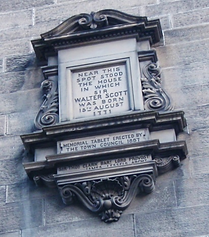
Walter Scott was born in College Wynd which was demolished and replaced with modern housing. The plaque can be seen on the wall at the corner of Guthrie Street and Chambers Street is to signify the location of the house where Sir Walter Scott was born in August 1771. Walter Scott's Birthplace Stone Guthrie Street Edinburgh


Old Fishmarket Close Swift’s Wynd Carmichael's Close
The Fish market was one of the casualties of the Great 1824 fire as it was destroyed. This close was originally known as Swift's Wynd a narrow street joining the Cowgate to High Street, the name recorded as far back as 1539. Alexander Swift owned a cellar at the head of the close and John Swift, a tenement. It then became Carmichael's Close in 1722 after Mr William Carmichael, advocate that lived there with his family. It was later renamed Fishmarket Close due to the fish market that was once active there. George Heriot known as “Jinglin’ Geordie”, the kings Jeweller and the founder of George Heriot’s Hospital (school), also lived in the close.
This was also a close that housed the first firefighting appliance.
At the foot of the Close on the west side was a property that was provided by the Council for the executioner. This gave the executioner easy access to both the Lawnmarket and Grassmarket place of Execution by hanging or beheading. The house also provided a prison room for the condemned on the night before their demise.


Sala del Sarto
Cowgate Edimburgo
L'incorporazione dei sarti dei registri Canongate risale al 1438 (registri nazionali della Scozia). L'incorporazione dei sarti acquistò un terreno nel Cowgate nel 1620. Il sito era dove costruirono la loro sala riunioni che fu completata entro l'anno successivo. Nel febbraio 1638 una bozza del Patto Nazionale fu approvata nella Sala del Sarto. L'edificio fu ampliato nel 1757 con un piano superiore. Gli edifici sono ora un bar e un alloggio. Il Patto nazionale fu firmato per la prima volta nel cimitero di Greyfriars a Edimburgo il 28 febbraio 1638 prima di viaggiare per il paese per le firme.

Ponti che attraversano
Cowgate Edimburgo
Il 2 ponti che attraversano il Cowgate a Edimburgo sono stati costruiti per consentire l'accesso al sud di Edimburgo. Il South Bridge fu completato nel 1788 ed era un'estensione del North Bridge e attraversò la High Street al Tron Kirk che fu a lungo il punto di riferimento per la vecchia Edimburgo. Il ponte Giorgio IV fu completato nel 1832, il che iniziato dal Lawnmarket ed era una continuazione di Bank Street e il Mound. Molte case e chiusure furono demolite per far posto ai ponti per consentire facili collegamenti con il sud di Edimburgo. Gli uffici della Società Mercanti di Edimburgo era dove ora sorge l'arco del Ponte Giorgio IV. Qui è stata fondata la prima scuola femminile da un dono di Mary Erskine nel 1694, noto come Merchant Maiden Hospital.


James Connolly Birthplace
James Connolly was born in Edinburgh at 107 Cowgate on 5 June 1868. The first time he stood on Irish soil was as a British soldier at the age of fourteen. He was the secretary of the Scottish Socialist Federation in 1892 aged 24.
He also founded the Irish Socialist Republican Party whose aims were to secure the national and economic freedom of the Irish people. He started a weekly newspaper, the Workers’ Republic and the first publication was issued in August of 1898. At the age of 46 in 1914 he became Acting General Secretary of Irish Transport and General Workers Union. He formed an Anti-War Committee and as the leader he Committed the Labour movement to oppose recruitment and conscription to the British Army ‘we serve neither King nor Kaiser, but Ireland’. When the Secret military council of the I.R.B. Decided on an armed rising in 1916, Connolly took part in the preparations and in 1916 he had become convinced that a nationalist revolution was the only way to free Ireland from what he saw as imperial and capitalist oppression. He was sentenced to death for his part in the uprising and was executed in Kilmainham Jail Dublin 12 May 1916.


Merchants of Edinburgh – Merchant Maidens Hospital
Merchant Company of Edinburgh
The Merchant Company of Edinburgh was established in 1681. The previous name was the Guidry before it became a society. Their first meeting hall was in the Cowgate Edinburgh and they then moved to Hunter Square before moving to its final home of Hanover Street. The Merchant Company was a watch dog for Edinburgh looking after the concerns and needs of the people. Over time the wealthy would leave their estates to be administered by the Merchant Company by way of a trust. This resulted in with well-judged investments the Merchant Company become the largest land owners in Scotland. The Merchant Company in 1694 with a donation from Mary Erskine a widow, which established Mary Erskine School. With other donations and bequests and trusts, further education facilities were opened, George Watson’s College in 1741, George Watson was an accountant, and merchant banker and the first accountant of the Bank of Scotland, James Gillespie’s High School in 1803, James Gillespie was a local Tobacconist in the High Street Edinburgh and Daniel Stewart held an appointment in the Court of Exchequer, Daniel Stewart’s College in 1855 which is now ESMS (Erskine, Stewart, Melville Schools). John Watson’s School in built in 1828 at 75 Belford Road next to the Dean Cemetery. The Edinburgh Chamber of Commerce was established as an off shoot of the Merchant’s Society of Edinburgh in 1786.
Magdalen Chapel Cowgate
The Magdalen Chapel was built by Michael Macquhane and his wife Michael died in 1537 and his wife managed the completion of the chapel in 1542. The Magdalen Chapel was a chapel and Hospital for the poor. The Incorporation of Hammermen took over the running of the building in 1547. On the plaque above the door show their initials MM. JR. and the date of Janet Rynd's death 1553. The Chapel was a place of worship and also the guild Hall for the incorporation of Hammermen. The Hammermen were metal workers and tradesmen who became the trustees of the Chapel and attached building a hospital, which is now a hostel. Inside the Chapel is an amazing stain glass window which features the Royal Arms of Scotland, the Arms of Mary of Guise, Mary Queen of Scots. mother Also still in the Chapel is the Deacon of the Hammermen's Guild of Edinburgh chair which was made in 1708. There are many other artefacts from Scottish history on display in the Chapel please arrange a visit as there is much to see.

Medical Missionary Society | Livingstone House
Edinburgh Medical Missionary Society moved into 39 Cowgate in 1858 which was then owned by the Scottish Reformation Society. The EMMS (Edinburgh Medical Missionary Society and Livingstone Institute) rebuilt in 1877 and operated a dispensary for the local people. The building occupied from the corner of Candlemakers' Row to the Magdalen Chapel. Above the entrance on the corner are 13 carved heads. The building housed a dispensary, waiting rooms, lecture theatre, students' bedrooms (the Livingston Residence), a working men's club and 3 shops.

Grapes

Frog

Plums

Knight’s Templar


Thistle

Acorns

English Rose

Devil


Cowgatehead Free Church
The Gothic church was founded in 1861 with money from William Whyte’s will. William Whyte bookseller to the Queen Dowager Adelaide wife of William IV. The stone panel on the tower above the door reads; 'Erected and endowed from funds bequeathed by William Whyte Edinburgh MDCCCLXI
