

Cowgate Attractions
Edinburgh
Cowgate Grassmarket Edinburgh was the road in to Edinburgh from the east. previously the south Loch before drained circa 1300. Named after the gate in the Flodden wall that surrounded Edinburgh. The Gate was the way the farmers brought their stock (Cow's) to market. Through the Cow gate of the City Wall (Flodden Wall). Now it is the hub of pubs, restaurants, clubs accommodation, within walking distance of all the attractions, historic sites, Royal Mile and Edinburgh Castle. There are some places that still exist in the Cowgate from Edinburgh's History; The Magdalen Chapel, James Connolly birthplace, St Patrick's Church, One of George Heriot's Schools, Tailors Hall, The first bridge to spa the Cowgate (South Bridge), the vaults created by the bridge that once were used as shops The history of Edinburgh is vast and I have hopefully given a good account of it on this site.


Cowgate Port + St Mary’s Port
St Mary’s Port across the Pleasance from Heriot’s Hospital to a building at the head of Back of Canongate South (now Holyrood Road). Cowgate Port across the Cowgate from Heriot’s Hospital to buildings on North of Cowgate.


Heriot’s Hospital (School)
Cowgate Edinburgh
Heriot’s Hospital (School) a building on the corner of the Cowgate and Pleasance in Edinburgh. It was built after the wall and Cowgate Port were removed for development and it is possible the stone from the wall and port were used to build the Hospital (school). This building is still standing originally built between 1838, the clock face has a date of 1840 and on the front of the building is an inscription George Heriot's | Hospital | School | 1838. This one of seven schools opened by the governors of Heriot’s school to give free education to poor children throughout the city.


St Patrick's R.C.
Cowgate Edinburgh
St Patrick’s Edinburgh was built in 1774. It was first Presbyterian then Episcopal and finally in 1856 it opened as a Catholic church to serve the growing Irish community in Edinburgh. There were reported to be 2600 attend the first service. In 1869 Canon Edward Hannan established the Catholic Young Men’s Society (CYMS) and started a football team to help the Irish Catholic community from Edinburgh’s Southside mix with the larger Edinburgh Catholic community. It was decided after many different names were rejected that the football club should be named Hibernian after the Roman name for Ireland. The Hibernian Football Club have been a part of Edinburgh sporting history ever since.

Cardinal Beaton
Cowgate Edinburgh
Cardinal David Beaton’s Palace
At the south west corner of Blackfriars Wynd and the boundary of the Cowgate stood the Archbishops Palace at the foot of Toddrick’s Wynd. Built in an L shape with a Porte-cochere giving access to a courtyard at the back. James (Bethune) Beaton lived here. The next resident was David Beaton nephew of James the Archbishop. The next to be resident was the High School of Edinburgh (Grammar Skule) prior to the new school building being completed where Blackfriars Monastery once stood. In February 1567 Mary Queen of Scots with her court went to the Cardinals Palace, where she had super before returning to Holyrood. This was the night Bothwell and accomplices made their way down Toddrick’s Wynd to Kirk o Field. The night Lord Darnley was murdered at Kirk o Field. The Palace and grounds were divided into lots where mostly poor Irish immigrants lived.

Cardinal Beaton Plaque
Cowgate Edinburgh
David Beaton was born in 1494 and died in 1546. On 20 December 1539 David Beaton was made a Cardinal by Pope Paul III. Cardinal Beaton became a regent for Mary Queen of Scots and appointed himself the Chancellor of Scotland in 1543. He was disliked by most but was in favour with the royals of both France and Britain. He had many mistresses and 20 illegitimate children. He was arrested for fraud and the cause of the rough wooing, Henry the VIII invasion of Scotland.


First Printing Press
Black Knight
This plaque donates the place where the first printing of a book in Scotland took place. The printers Walter Chepman and Andrew Myllar printed the first book in 1508 after being granted a licence by King (James IV) a year earlier.
The printers stood in the Cowgate at the foot of Blackfriars Street near to Cardinal Beaton’s House.

Robert Louis Stevenson Plaque
Cowgate Edinburgh
“To look over the South Bridge and see the Cowgate below full of crying hawkers, is to view one rank of society from mother in a twinkling of an eye”. Robert Louis Stevenson 1878. The plaque can be found on the wall of the Rowantree a Venue in the Cowgate, Edinburgh EH1 1NN near the South Bridge.

South Bridge
Bridges over Cowgate
The South Bridge was constructed circa 1788, due to the ground and valleys the bridge was constructed with
19 arches. The arch that spans the Cowgate is the only one that is visible. Underground can be seen vaults that were made due to the bridge. The vaults were occupied by tradesmen, shops and taverns the first underground shopping mall. Due to the conditions of the vaults with lack of light and air, the vaults were soon abandoned.
Cowgate to St Mary’s Street Cowgate to George IV Bridge


Underground Vaults
The South Bridge was constructed circa 1788 due to the ground and valleys the bridge was constructed with 19 arches. The arch that spans the Cowgate is the only one that is visible. Underground can be seen vaults that were made due to the bridge. The vaults were occupied by tradesmen, shops and taverns the first underground shopping mall. This did not last due to the conditions of the vaults with lack of light and air, the vaults were soon abandoned. It is not known when the vaults complex was closed down, with some suggesting as early as c. 1835 and others as late as c. 1875. Written records regarding the vaults during their slum use are virtually non-existent. There are areas within The Caves that are the building remains of what was Adam Square, which was demolished to make way for the erection of the South Bridge. The original terracotta floor tiles, a hearth stone, and what remains of a fireplace, were found in one of the rooms within The Caves whilst it was being excavated. In another room, within The Caves, a well was found. South Bridge started in 1785, when the 19 arches to support it were built. The vaults, chambers and tunnels underneath it were walled in and sectioned off the descending levels. By 1788, when South Bridge was officially opened, approximately 120 vaults, or rooms, were ready.

Blair Street
Blair Street was formed when the South Bridge was being built in 1768. To give access to the Cowgate from the High Street, at that time Marlin’s Wynd and Pebble's Wynd were demolished in 1785 with the west side of Niddry Street. Blair Street as Hunter Square was named after Lord Provost Sir James Hunter Blair.
Marlin’s (Merlyoune) Wynd
Marlin’s Wynd is below the level of the present streets as Mary King’s Close is. Marlin’s Wynd was to the west of the Tron Kirk and ran down to the Cowgate. Named after John Merlyoune (Marlin), who was in charge of paving the High Street. He requested in memory of his work that he would be buried underneath the paving stones. He was buried at the head of the Wynd (which was named after him) by paving stones in the shape of a grave. Other writings mention that the High Street was paved in 1532 by two brothers John and Bartoulme Foliot.
Also a John Merlyoune was first to pave Marlin's Wynd 1542.

Free Cowgate Church (Stramash)
Church built in 1859, was built by Edinburgh architect Patrick Wilson.
The panel above the door reads;
'Erected and endowed from funds bequeathed by William Whyte Edinburgh MDCCCLXI’.

Guthrie Street | College Wynd
Guthrie Street was built to replace College Wynd and was named after Dr Thomas Guthrie the founder of the first Ragged School in 1841, which can be seen in Ramsay Lane of Castlehill Royal Mile Edinburgh. Guthrie Street is a link between Chambers Street and the Cowgate Edinburgh. There are steps from Chamber Street to Guthrie Street which was previously West College Street before Chamber Street was built.
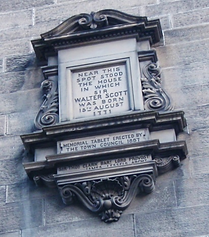
Walter Scott was born in College Wynd which was demolished and replaced with modern housing. The plaque can be seen on the wall at the corner of Guthrie Street and Chambers Street is to signify the location of the house where Sir Walter Scott was born in August 1771. Walter Scott's Birthplace Stone Guthrie Street Edinburgh


Old Fishmarket Close Swift’s Wynd Carmichael's Close
The Fish market was one of the casualties of the Great 1824 fire as it was destroyed. This close was originally known as Swift's Wynd a narrow street joining the Cowgate to High Street, the name recorded as far back as 1539. Alexander Swift owned a cellar at the head of the close and John Swift, a tenement. It then became Carmichael's Close in 1722 after Mr William Carmichael, advocate that lived there with his family. It was later renamed Fishmarket Close due to the fish market that was once active there. George Heriot known as “Jinglin’ Geordie”, the kings Jeweller and the founder of George Heriot’s Hospital (school), also lived in the close.
This was also a close that housed the first firefighting appliance.
At the foot of the Close on the west side was a property that was provided by the Council for the executioner. This gave the executioner easy access to both the Lawnmarket and Grassmarket place of Execution by hanging or beheading. The house also provided a prison room for the condemned on the night before their demise.


Tailor's Hall
Cowgate Edinburgh
The Incorporation of Tailors of the Canongate records go back as far as 1438 (National records of Scotland).The incorporation of Tailors purchased land in the Cowgate in 1620. The site was where they built their meeting hall which was completed by the next year. In February 1638 a draft copy of the National Covenant was approved in the Tailor’s Hall with signatures from over 200 clergy. It was changed into a Playhouse, circa 1725 the building purchased 1755 and was extended in 1757 by the Argyle Brewery by the way of an upper floor. The buildings are now a bar and accommodation.. The National Covenant was first signed at Greyfriars churchyard Edinburgh on the 28th of February 1638 before travelling the country for signatures.

George IV Bridge
Spanning Cowgate Edinburgh
The George IV Bridge was completed in 1832 which started from the Lawnmarket and was a continuation of Bank Street and the Mound. Many houses and closes were demolished to make way for the bridges to enable easy connections to south Edinburgh. The offices of the Merchants Company of Edinburgh was where the arch of the George IV Bridge stands now. This was where the first ladies school was established by a gift from Mary Erskine in 1694, known as the Merchant Maiden Hospital.


James Connolly Birthplace
James Connolly was born in Edinburgh at 107 Cowgate on 5 June 1868. The first time he stood on Irish soil was as a British soldier at the age of fourteen. He was the secretary of the Scottish Socialist Federation in 1892 aged 24.
He also founded the Irish Socialist Republican Party whose aims were to secure the national and economic freedom of the Irish people. He started a weekly newspaper, the Workers’ Republic and the first publication was issued in August of 1898. At the age of 46 in 1914 he became Acting General Secretary of Irish Transport and General Workers Union. He formed an Anti-War Committee and as the leader he Committed the Labour movement to oppose recruitment and conscription to the British Army ‘we serve neither King nor Kaiser, but Ireland’. When the Secret military council of the I.R.B. Decided on an armed rising in 1916, Connolly took part in the preparations and in 1916 he had become convinced that a nationalist revolution was the only way to free Ireland from what he saw as imperial and capitalist oppression. He was sentenced to death for his part in the uprising and was executed in Kilmainham Jail Dublin 12 May 1916.


Merchants of Edinburgh – Merchant Maidens Hospital
Merchant Company of Edinburgh
The Merchant Company of Edinburgh was established in 1681. The previous name was the Guidry before it became a society. Their first meeting hall was in the Cowgate Edinburgh and they then moved to Hunter Square before moving to its final home of Hanover Street. The Merchant Company was a watch dog for Edinburgh looking after the concerns and needs of the people. Over time the wealthy would leave their estates to be administered by the Merchant Company by way of a trust. This resulted in with well-judged investments the Merchant Company become the largest land owners in Scotland. The Merchant Company in 1694 with a donation from Mary Erskine a widow, which established Mary Erskine School. With other donations and bequests and trusts, further education facilities were opened, George Watson’s College in 1741, George Watson was an accountant, and merchant banker and the first accountant of the Bank of Scotland, James Gillespie’s High School in 1803, James Gillespie was a local Tobacconist in the High Street Edinburgh and Daniel Stewart held an appointment in the Court of Exchequer, Daniel Stewart’s College in 1855 which is now ESMS (Erskine, Stewart, Melville Schools). John Watson’s School in built in 1828 at 75 Belford Road next to the Dean Cemetery. The Edinburgh Chamber of Commerce was established as an off shoot of the Merchant’s Society of Edinburgh in 1786.
Magdalen Chapel Cowgate
The Magdalen Chapel was built by Michael Macquhane and his wife Michael died in 1537 and his wife managed the completion of the chapel in 1542. The Magdalen Chapel was a chapel and Hospital for the poor. The Incorporation of Hammermen took over the running of the building in 1547. On the plaque above the door show their initials MM. JR. and the date of Janet Rynd's death 1553. The Chapel was a place of worship and also the guild Hall for the incorporation of Hammermen. The Hammermen were metal workers and tradesmen who became the trustees of the Chapel and attached building a hospital, which is now a hostel. Inside the Chapel is an amazing stain glass window which features the Royal Arms of Scotland, the Arms of Mary of Guise, Mary Queen of Scots. mother Also still in the Chapel is the Deacon of the Hammermen's Guild of Edinburgh chair which was made in 1708. There are many other artefacts from Scottish history on display in the Chapel please arrange a visit as there is much to see.

Medical Missionary Society | Livingstone House
Edinburgh Medical Missionary Society moved into 39 Cowgate in 1858 which was then owned by the Scottish Reformation Society. The EMMS (Edinburgh Medical Missionary Society and Livingstone Institute) rebuilt in 1877 and operated a dispensary for the local people. The building occupied from the corner of Candlemakers' Row to the Magdalen Chapel. Above the entrance on the corner are 13 carved heads. The building housed a dispensary, waiting rooms, lecture theatre, students' bedrooms (the Livingston Residence), a working men's club and 3 shops.

Grapes

Frog

Plums

Knight’s Templar


Thistle

Acorns

English Rose

Devil


Cowgatehead Free Church
The Gothic church was founded in 1861 with money from William Whyte’s will. William Whyte bookseller to the Queen Dowager Adelaide wife of William IV. The stone panel on the tower above the door reads; 'Erected and endowed from funds bequeathed by William Whyte Edinburgh MDCCCLXI
